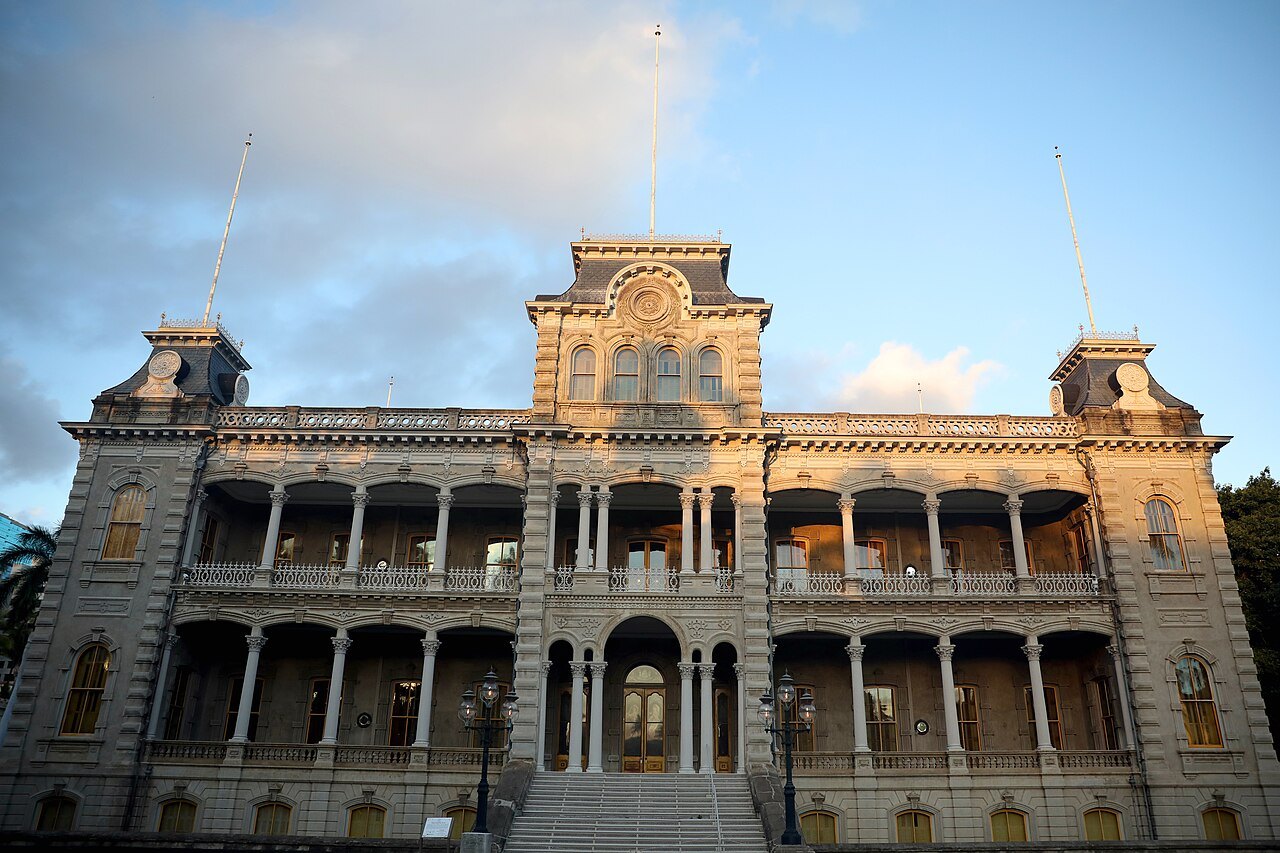
The Hawaiian Kingdom in Honolulu, and How It Ended
Why this page
Most American cities have no royal past. Honolulu does, and it is on the street in front of you: ʻIolani Palace, Aliʻiōlani Hale with the statue of Kamehameha I, Kawaiahaʻo Church where the kings took their oaths, and Washington Place beside the State Capitol, where the last queen lived. The end of the kingdom is still debated in Hawaiʻi, and it matters to many people who live here. This page sets out what happened, from the historical record and the findings of the United States government itself, without softening it and without adding judgments of its own.
A kingdom of the islands
The Hawaiian Kingdom was founded in 1795, when Kamehameha I, a chief from the island of Hawaiʻi, conquered Oʻahu, Maui, Molokaʻi and Lānaʻi and united them under one rule. In 1810 Kauaʻi and Niʻihau joined by agreement, and all the inhabited islands formed a single kingdom. It was ruled first by the house of Kamehameha and then by the house of Kalākaua, and it was recognized as an independent state by the powers of Europe and by the United States.
Its kings modernized it quickly. Kamehameha III proclaimed a first constitution in 1840 and a second in 1852, and in 1848 carried out the Great Māhele, the division of land that introduced private ownership. In 1843 a British naval captain, Lord George Paulet, seized the islands; that July a British admiral, Richard Thomas, restored them to the king, at a ceremony on the ground that became Thomas Square. In 1845 Kamehameha III moved the court and capital to Honolulu, and he and his successors built the city into a capital.
The same decades brought catastrophe. Traders, whalers and settlers introduced diseases, among them smallpox, measles and tuberculosis, and the Native Hawaiian population fell sharply. At the same time American missionary families and their descendants built up businesses in Honolulu, and sugar plantations drew workers from Asia, reshaping the islands' people and economy.
The Bayonet Constitution
In 1887 a volunteer militia recruited from American settlers, the Honolulu Rifles, forced King Kalākaua to accept a new constitution under threat of force; it became known as the Bayonet Constitution. It took from the king the power to dismiss his ministers without the legislature's approval, raised the property qualification for voting, and denied the vote to Asians, who made up a large share of the population. Power shifted toward the business community of Euro-American settlers.
Kalākaua died in 1891 and his sister, Liliʻuokalani, succeeded him. She wanted to restore the monarch's powers by replacing the 1887 constitution, and she toured the islands and received a long petition in support of a new one.
The overthrow of 1893
In January 1893 the Committee of Safety, a group of Honolulu residents, most of them of American descent, organized to depose the queen and seek annexation to the United States. At their request, the American minister, John L. Stevens, had 162 sailors and Marines landed from the USS Boston on 16 January to take up positions in the city. The next day, 17 January, the Committee proclaimed the end of the monarchy and a Provisional Government. The troops did not enter the palace grounds or fire a shot, but their presence was decisive; the queen had no army to call on, and the police did not rally to her.
To avoid bloodshed, Liliʻuokalani yielded, and in her written statement she said she did so “to the superior force of the United States of America,” under protest, until the United States should undo the action of its representatives and restore her.
What Washington found
The new American president, Grover Cleveland, sent James Blount to investigate. His report of July 1893 concluded that United States diplomatic and military representatives had abused their authority and were responsible for the change of government. Cleveland told Congress that the honorable course was to undo the wrong and restore the previous government as far as practicable. A Senate committee led by John Tyler Morgan then produced a report that contradicted Blount's and cleared Stevens and the troops. Cleveland's efforts stalled, and the United States recognized the Provisional Government and the Republic that followed it.
Republic, annexation, territory
The Committee declared the Republic of Hawaiʻi in 1894. In January 1895, after an armed attempt by royalists to restore the monarchy failed, the queen was arrested at Washington Place, tried by a military tribunal and imprisoned for nine months in a room of her own palace. In 1897 Hawaiian organizations gathered 21,269 signatures on a petition against annexation, more than half of the Native Hawaiian population of the time.
A treaty of annexation signed by President William McKinley in 1897 lacked the two-thirds support it needed in the Senate, but on 7 July 1898 Congress annexed the Republic by joint resolution, the Newlands Resolution, and on 12 August American troops raised the flag of the United States at the palace; the queen and many Hawaiian nobles stayed away. In 1900 Congress created the Territory of Hawaiʻi, and in 1946 the United Nations listed Hawaiʻi as a non-self-governing territory administered by the United States. In June 1959, in a plebiscite with the highest turnout in the islands' history, at least 93 percent of voters on every major island approved statehood, and Hawaiʻi became the fiftieth state on 21 August 1959.
The apology, and today
In 1993, on the hundredth anniversary, Congress passed and President Bill Clinton signed the Apology Resolution. It acknowledges that the overthrow occurred with the active participation of agents and citizens of the United States, and that the Native Hawaiian people never directly gave up their claims to sovereignty over their national lands through their monarchy or by any plebiscite or referendum.
Opposition to the overthrow and annexation lies at the root of the Hawaiian sovereignty movement, some of whose supporters call for independence. The flag of Hawaiʻi flies alone, without the American flag, at the palace and at only a few other places in the islands. For visitors, the right response is to listen and to learn; the palace tour, Bishop Museum and the journal are good places to start.
More photographs
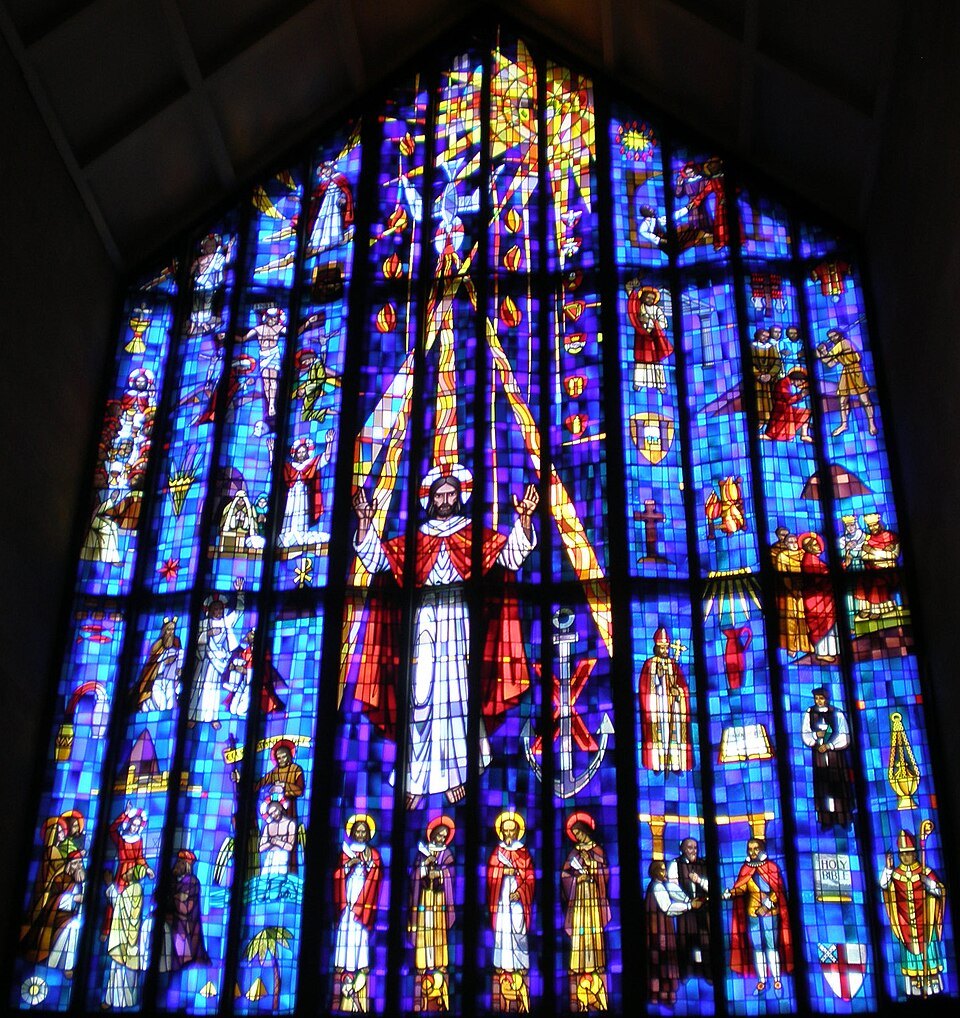
The great stained-glass west window of St. Andrew's CathedralJoel Bradshaw, Wikimedia Commons, Public domain