Home · Sights · Aliʻiōlani Hale and the Kamehameha Statue
Aliʻiōlani Hale and the Kamehameha Statue
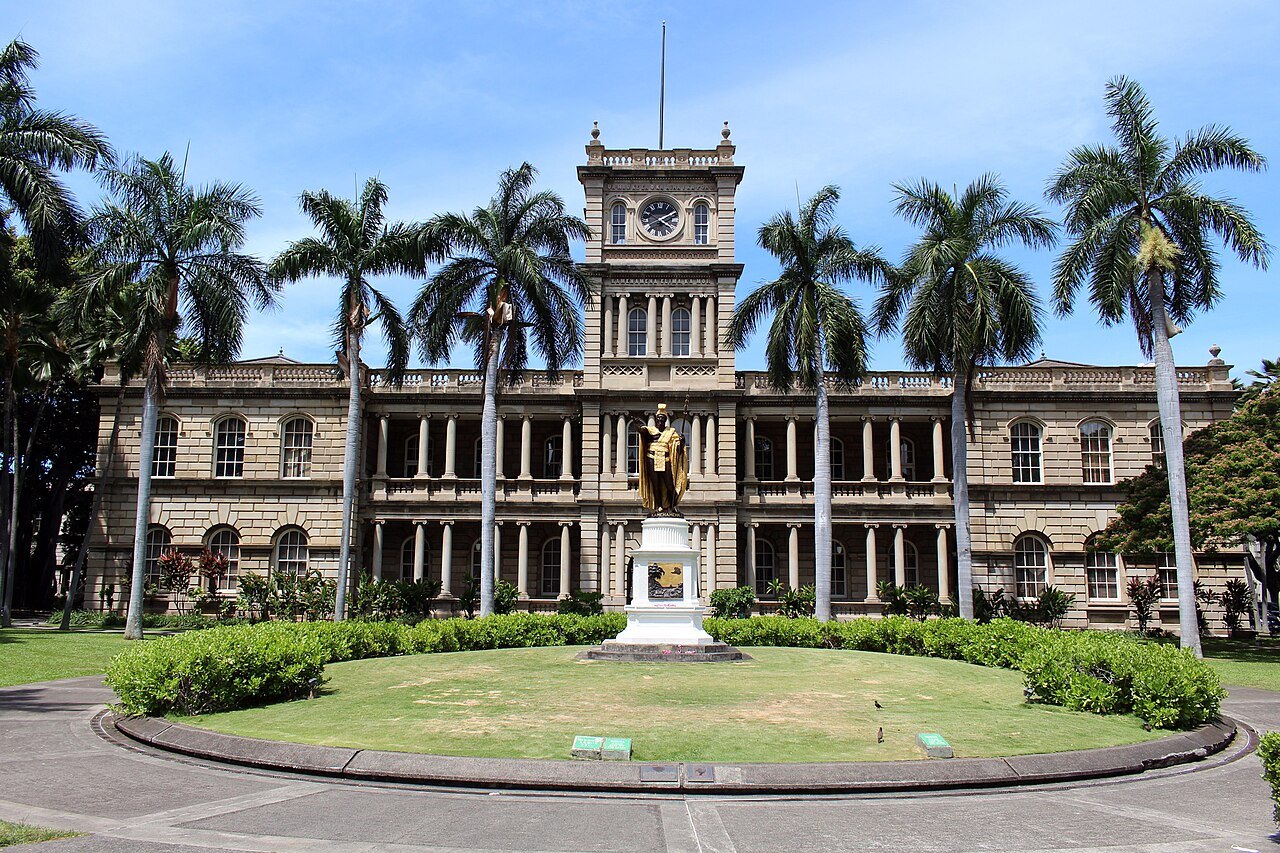
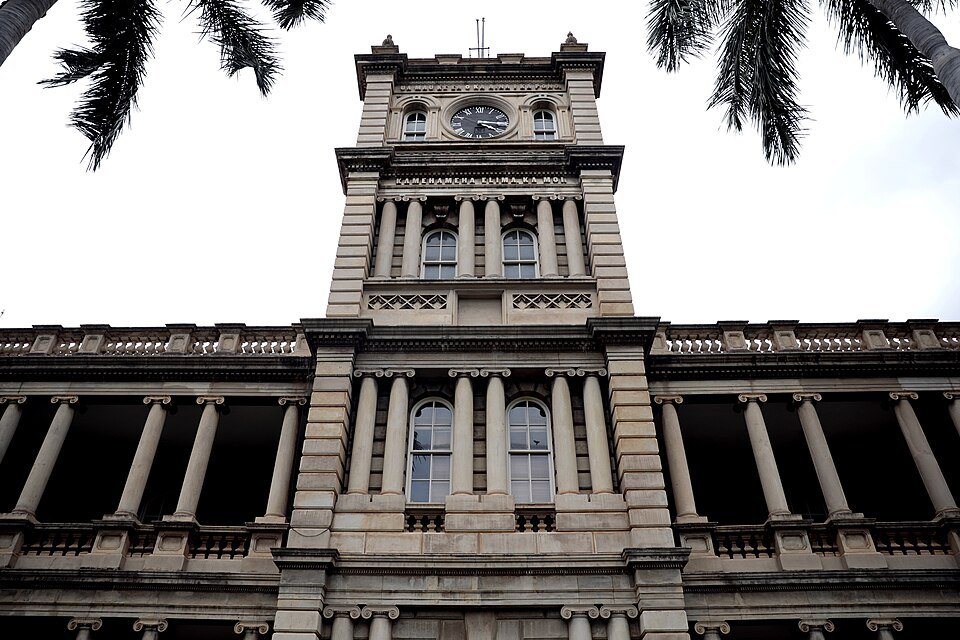
- iThe clock towerA tall central tower over the entrance, the building's landmark from King Street and the palace lawn.
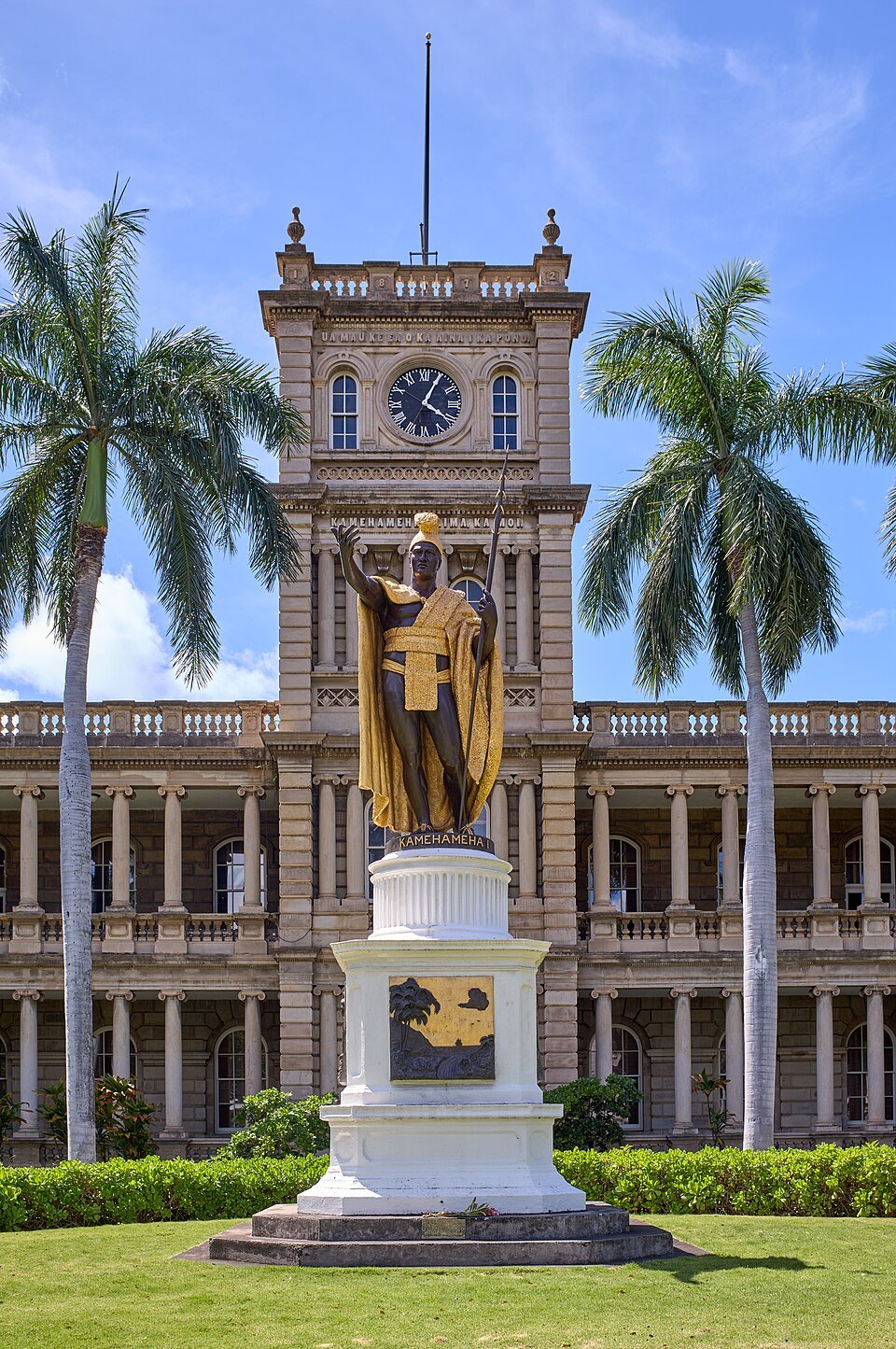
- iiThe Kamehameha statueKamehameha I in gilded bronze, arm outstretched and spear in hand, on a stone pedestal before the steps.
- iiiThe Judiciary History CenterA museum inside with a restored historic courtroom and exhibits on the courts of Hawaiʻi.
- ivThe Italianate frontAn arcaded facade in the Italian Renaissance Revival style, designed by the Australian architect Thomas Rowe.
- vThe forecourt lawnThe open ground between the statue and the street, facing ʻIolani Palace across King Street.
Reading the place
Why it matters
Aliʻiōlani Hale, “the house of heavenly kings,” was the seat of government of the Hawaiian Kingdom, and later of the Republic of Hawaiʻi, and it houses the Hawaiʻi State Supreme Court today. It stands on King Street directly across from ʻIolani Palace, and in front of it stands the gilded statue of Kamehameha I, the conqueror who founded the kingdom and by 1810 had brought all the main islands under one rule.
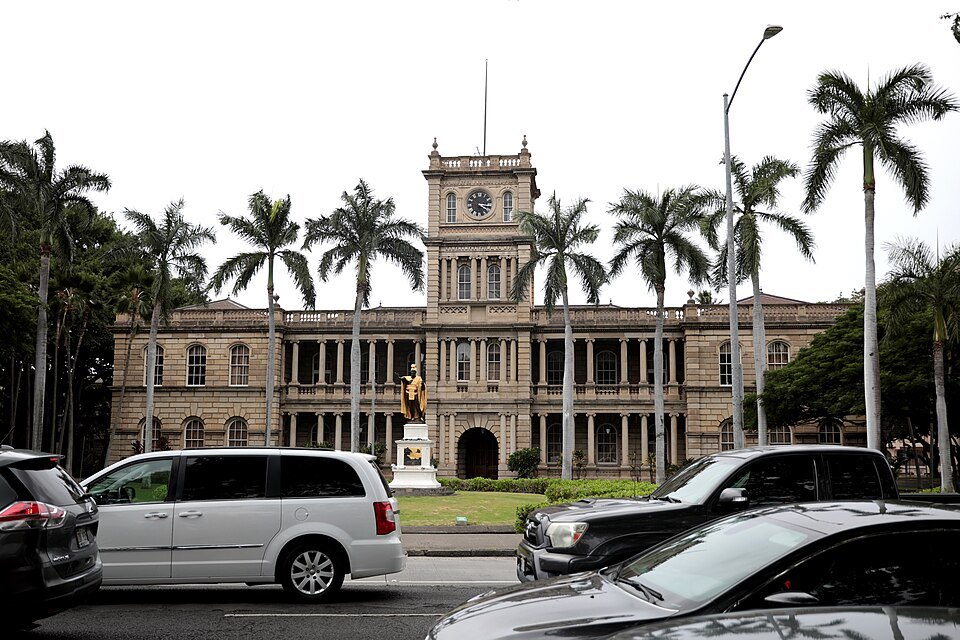
The two belong to the same story. The building was the working center of the kingdom's government; the statue was ordered to honor its founder; and in 1893 the building was at the center of the events that ended that kingdom.
A palace that became an office
The building was designed by Thomas Rowe in the Italian Renaissance Revival style, first as a royal palace for King Kamehameha V, whose own given names included Aliʻiōlani. But the kingdom's government was working out of a scatter of small, cramped buildings, and the king decided it needed offices more than he needed a palace. He laid the cornerstone on 19 February 1872 and ordered the building finished as a government house.
Kamehameha V died before it was complete, and King Kalākaua dedicated it in 1874. Newspapers of the day called the design extravagant and suggested it be turned back into a palace. Until 1893 it held most of the executive departments of the kingdom, as well as the legislature and the courts.
In 2005, researchers used ground-penetrating radar to locate the time capsule Kamehameha V had buried under the cornerstone, holding photographs of the royal families, the kingdom's constitution, stamps, coins and newspapers. It was left where it lies, so as not to damage the building.
The building in 1893
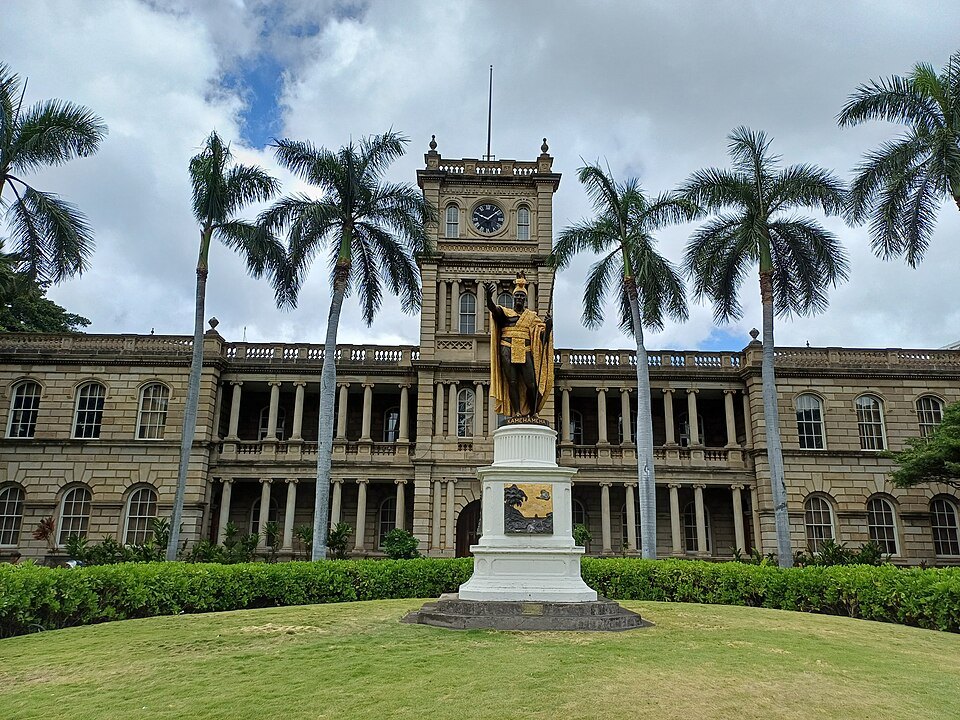
In January 1893 the armed supporters of the Committee of Safety occupied Aliʻiōlani Hale and waited there for Queen Liliʻuokalani's response to their ultimatum; the Committee then proclaimed the end of the monarchy and the start of a Provisional Government. After the Republic of Hawaiʻi was declared in 1894, the legislature and other offices moved across the street into the palace, and Aliʻiōlani Hale became mainly a courthouse. The full account is on the kingdom page.
The territory outgrew it. In 1911 the interior was gutted and rebuilt to a new plan better suited to courts, and in the 1940s a wing was added in a style meant to blend with the original. Over later decades most state courts moved elsewhere, leaving the Supreme Court and the administration of the judiciary.
The statue and the shipwreck
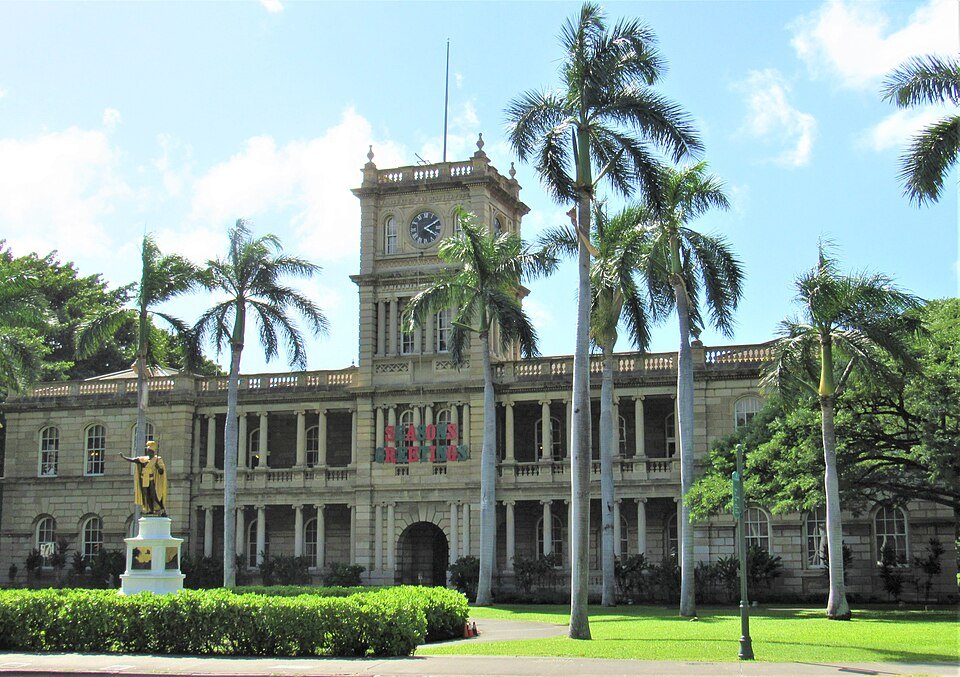
The statue began in 1878, when Walter M. Gibson, a member of the government, proposed a monument for the hundredth anniversary of Captain Cook's arrival in the islands. The commission went to Thomas R. Gould, a Boston sculptor working in Florence. Gould had little to go on: an engraving of an elderly Kamehameha and photographs of Polynesian men. Studying Roman sculpture in Italy, he gave the king the stance of a Roman general, with the gesturing arm, the spear and the cloak. The sash at the waist stands for the sacred sash of Līloa.
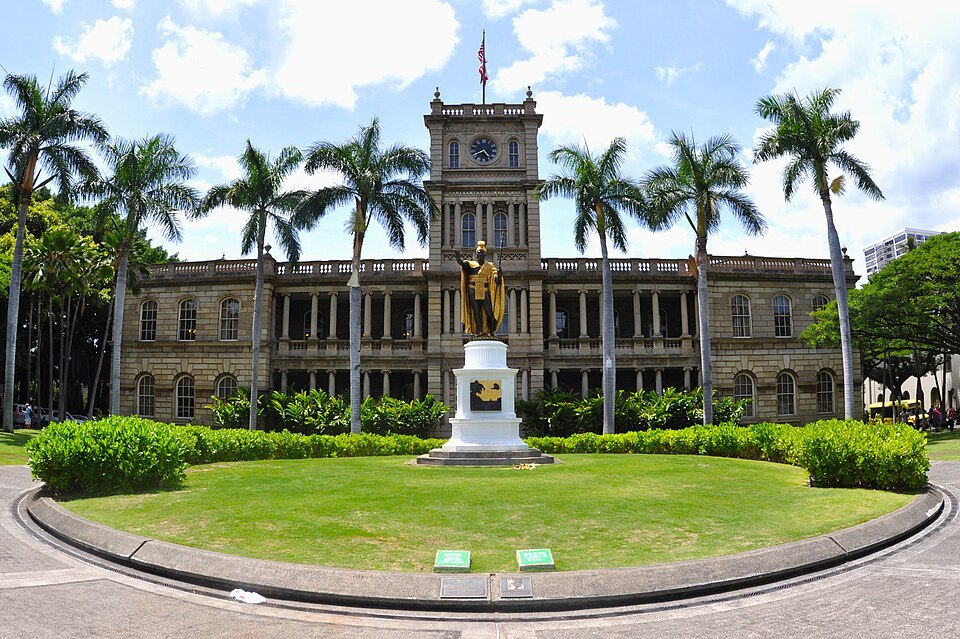
The first casting, made in Paris in 1880, went down with its ship near the Falkland Islands. It was insured, and a second casting was ordered. Then Falkland Islanders recovered the original and sold it to a sea captain, who brought it to Honolulu. That first statue, repaired, was sent to Kamehameha's birthplace in Kohala on Hawaiʻi Island. The second casting arrived in Honolulu on 31 July 1883, and it is the one that stands here.
A third casting was made when Hawaiʻi became a state and was unveiled in 1969 in the United States Capitol, where it stands in Emancipation Hall. So the king appears three times from one model: in Kohala, in Washington, and here on King Street, the only one of the three in Honolulu, where he kept his court for a few years from 1809.
What you see
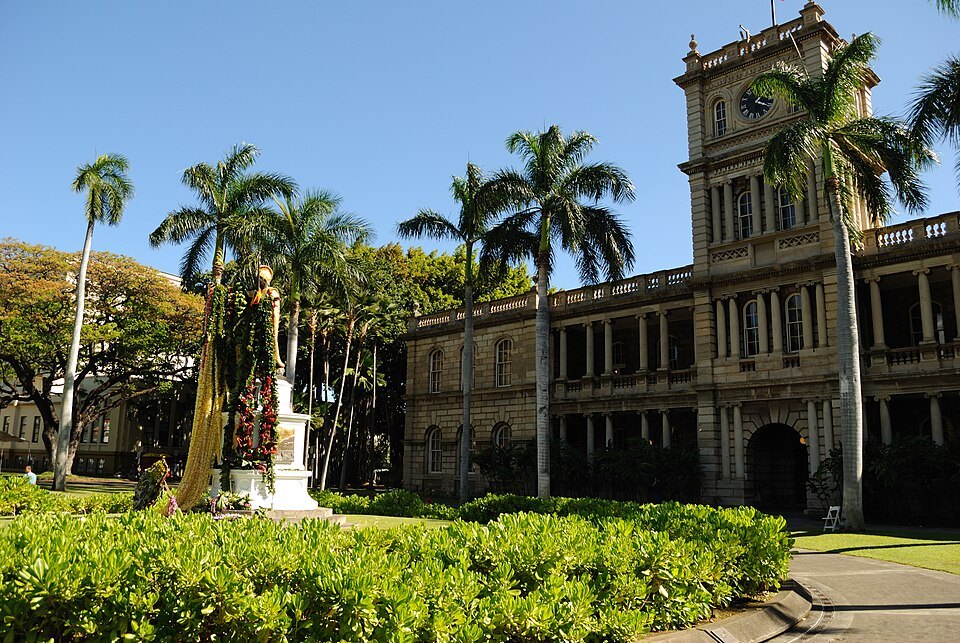
From the palace lawn, the building reads as a long arcaded front of two stories, with a clock tower above the central entrance. The statue stands on its pedestal in the forecourt, gilded and dark, facing the palace. Inside, the King Kamehameha V Judiciary History Center has a restored historic courtroom and exhibits on the history of Hawaiʻi's courts and landmark cases.
Every year on or near 11 June, King Kamehameha Day, the statue is draped with long lei made by hand, and people come to see it. It is a ceremony, not a photo backdrop; stand back while it is under way.
How to visit
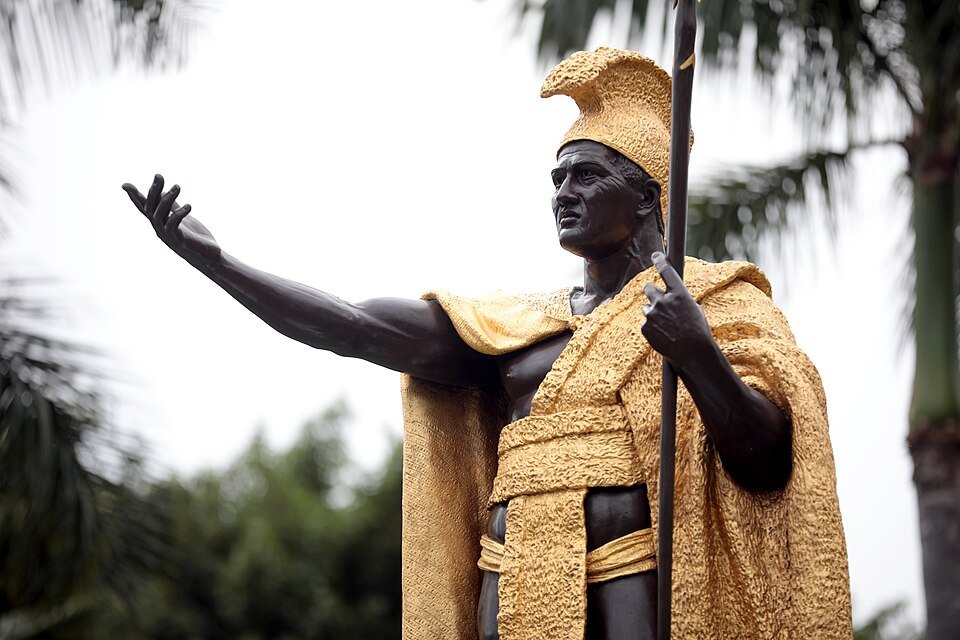
The statue and the front of the building can be seen at any time from the street and the forecourt, and the view is best from the palace side of King Street. The Judiciary History Center welcomes visitors on weekdays; check its own page for the days it keeps and for group tours, which are arranged by reservation. The building also holds the largest law library in Hawaiʻi.
Combine it with the palace across the street, the State Capitol and Washington Place behind it, and Kawaiahaʻo Church a short walk east. Getting around explains the buses from Waikīkī.
Honest notes
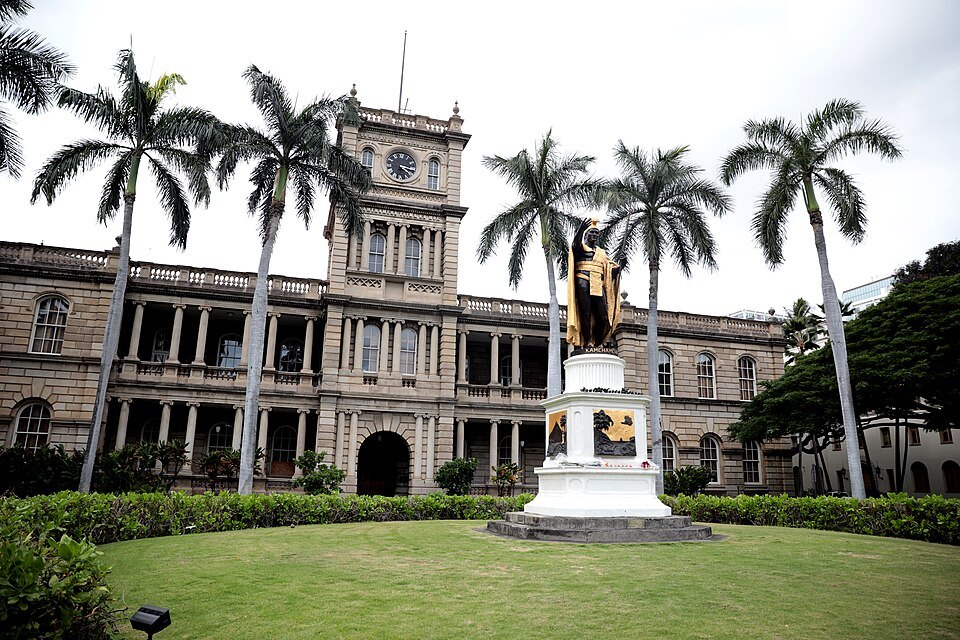
On the television series Hawaii Five-0, Aliʻiōlani Hale stands in for the headquarters of the task force and is called ʻIolani Palace; the real palace is the building across the street. And the statue is an artist's idealization, made by a sculptor who never saw his subject and worked in Italy from an engraving; it is a monument, not a portrait.
Nearby
- NearbyʻIolani PalaceCompleted for King Kalākaua in 1882, the seat of the Hawaiian Kingdom until its overthrow in 1893, the queen's prison in 1895, a government office for most of the twentieth century, and a museum since 1978.Read the page
- NearbyThe State Capitol and Washington PlaceA capitol opened in 1969 whose columns are palms and whose chambers are volcanoes, open to the sky; beside it Washington Place, where Queen Liliʻuokalani was arrested in 1895 and lived until her death.Read the page
- NearbyKawaiahaʻo Church and the Mission HousesThe church the Hawaiian kings took their oaths in, built between 1836 and 1842 of some 14,000 blocks of coral that divers cut from the reef, and beside it the houses of the missionaries who arrived in 1820.Read the page