Home · Sights · Kawaiahaʻo Church and the Mission Houses
Kawaiahaʻo Church and the Mission Houses
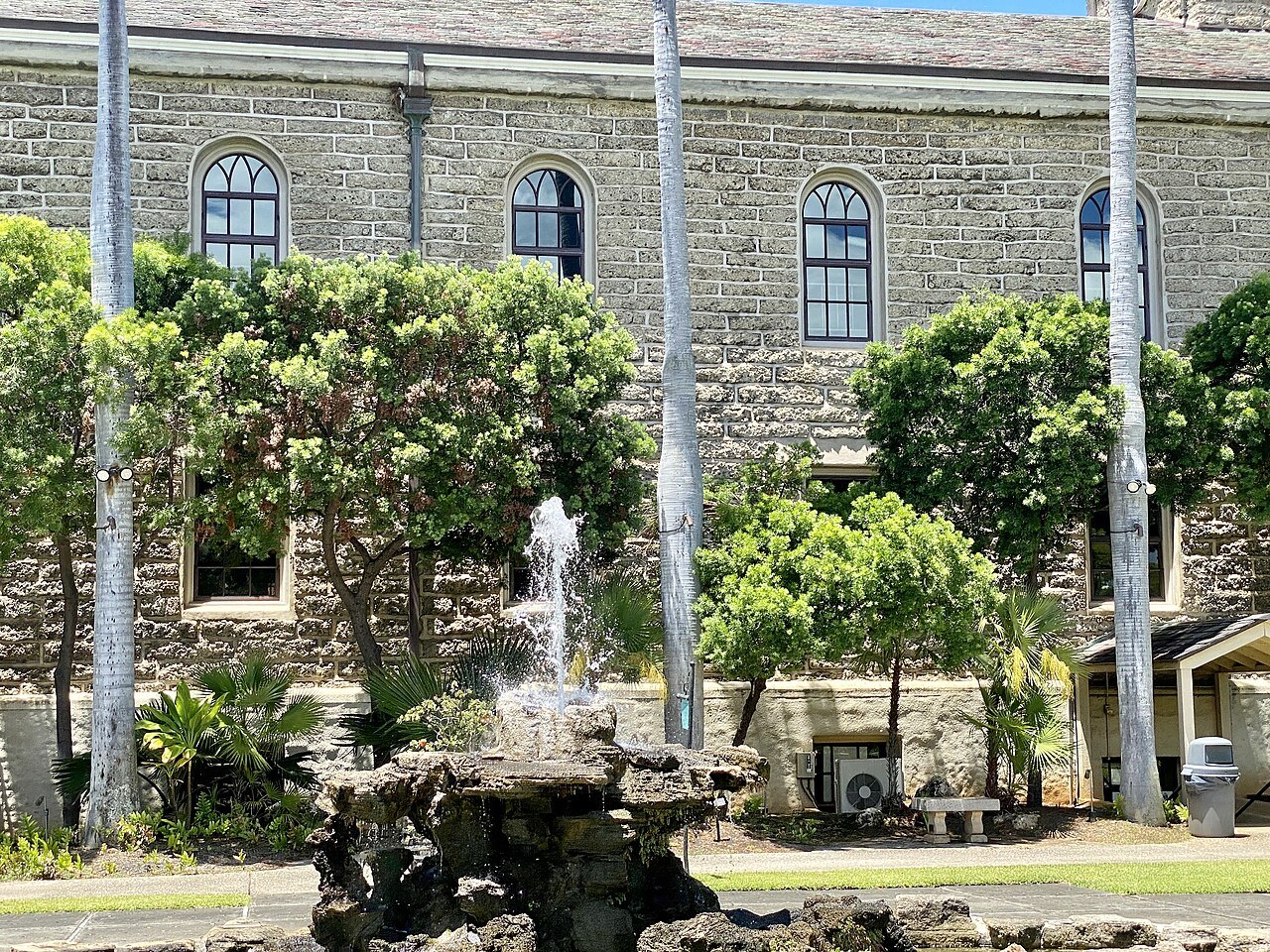
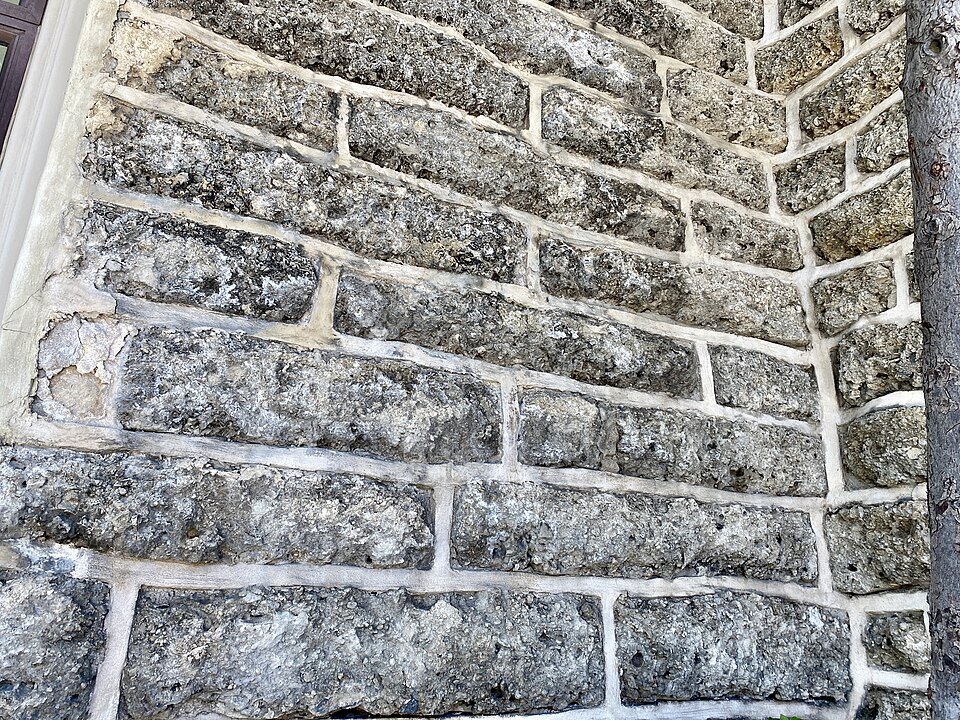
- iThe coral-block wallsWalls laid from some 14,000 slabs of reef coral, each cut underwater by hand and carried ashore.
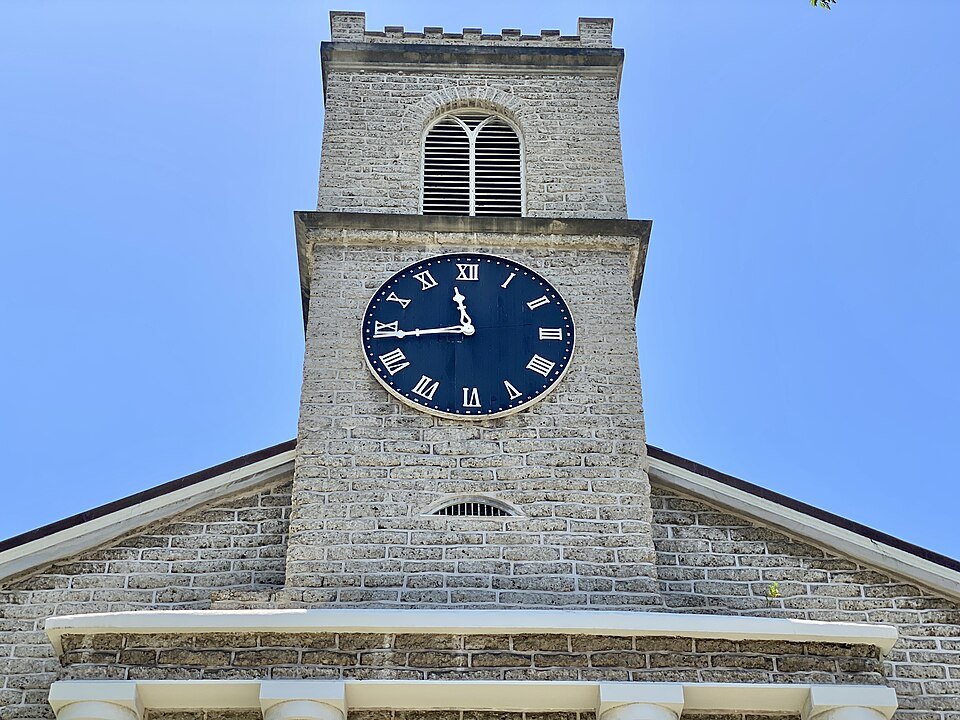
- iiThe clock towerA square tower over the entrance in the New England style the missionaries brought with them.
- iiiThe royal portraitsTwenty portraits of Hawaiian aliʻi hung around the upper gallery of the sanctuary.
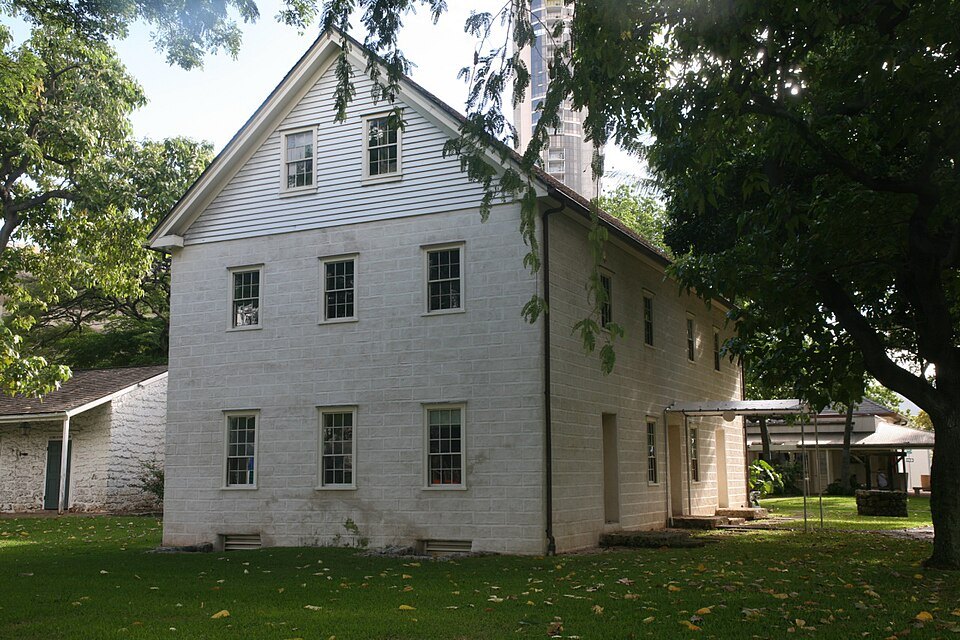
- ivThe oldest frame houseA wooden house shipped precut from Boston around Cape Horn in 1821, the oldest in the islands.
- vThe Chamberlain HouseA coral-block storehouse and home of 1831, now the museum's main exhibition hall.
- viThe Print HouseA small coral building where the first materials in the Hawaiian language were printed.
Reading the place
Why it matters
Kawaiahaʻo Church is the oldest church on Oʻahu and one of the oldest standing Christian places of worship in the islands. It was for a time the central church of the Hawaiian Kingdom and the chapel of the royal family, and it is still called “Hawaiʻi's Westminster Abbey.” Kamehameha III, Kamehameha IV, Kamehameha V and Kalākaua took their oaths of office to their constitutions here, and it held royal baptisms and state funerals.
The congregation still uses the Hawaiian language for parts of its services. Beside the church, the Hawaiian Mission Houses keep the first homes of the American Protestant missionaries who arrived in 1820, whose work, for better and worse, reshaped the islands' religion, language and government in the decades that followed.
A church built from the sea
The mission at this site began in 1820, and four thatched churches stood at or near it before the present building. The stone church was commissioned by the regency of Kaʻahumanu, during the reigns of Kamehameha II and Kamehameha III, and designed by the missionary Hiram Bingham in the plain New England style his mission favored. It was built between 1836 and 1842.
What makes it remarkable is its material. Its walls are laid from some 14,000 slabs of coral, each weighing about a thousand pounds, quarried from a reef off the south shore of Oʻahu. Hawaiian divers went down three to six meters below the surface to cut each block by hand, and the blocks were hauled from the reef to the shore and up to the site. Look closely at the walls and you can see the texture of the reef in the stone.
The name Kawaiahaʻo, “the water of Haʻo,” was only given to the site in 1853. It comes from a spring and freshwater pool that belonged to a high chiefess named Haʻo.
The church of the kings
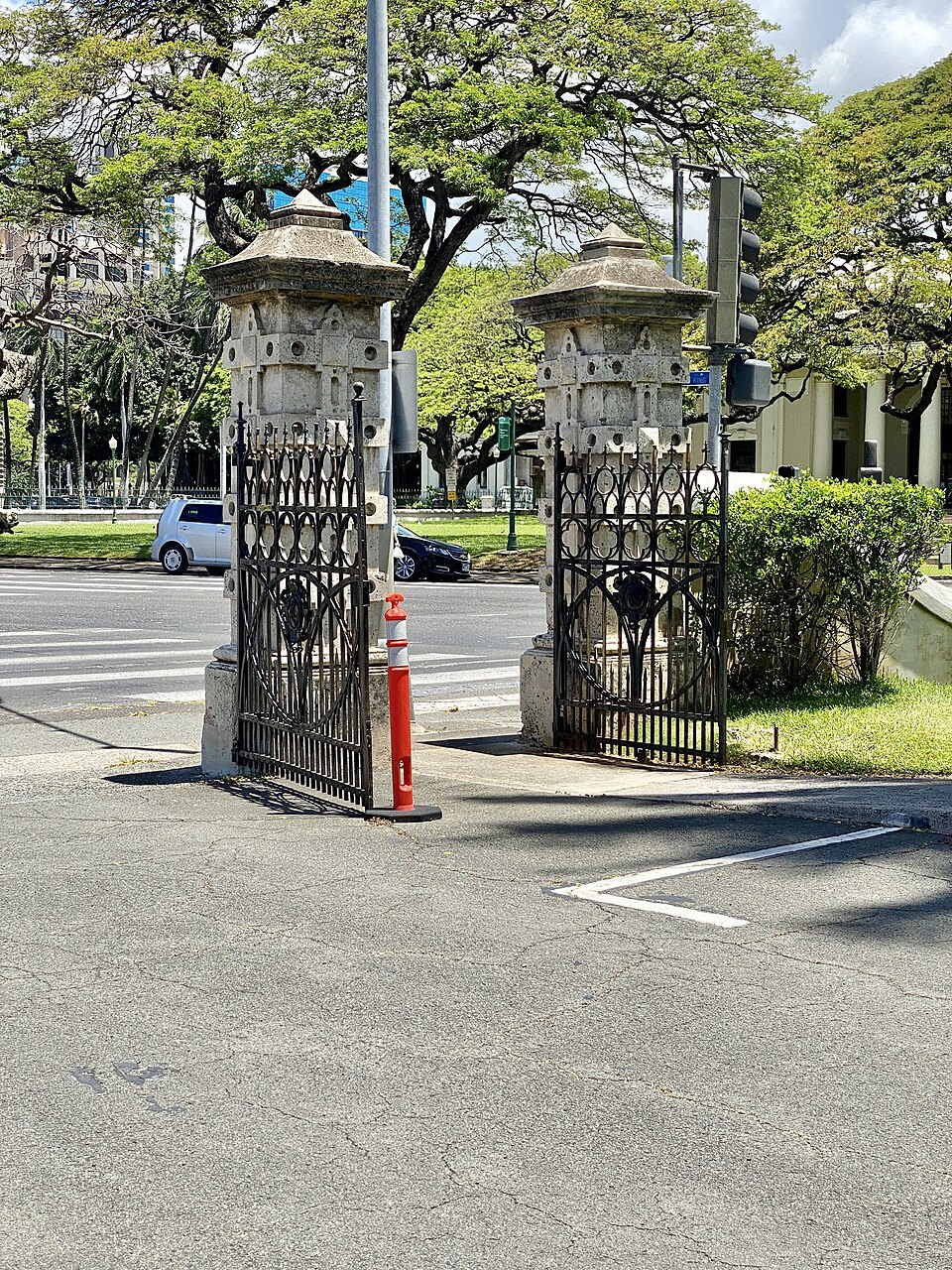
Chiefs and members of the Kamehameha and Kalākaua dynasties worshipped here, and the upper gallery of the sanctuary is hung with twenty portraits of Hawaiian aliʻi. King Lunalilo, who reigned briefly before Kalākaua, asked to be buried in the churchyard rather than in the Royal Mausoleum, and his tomb stands near the front courtyard. It is a royal grave: look from the path, and leave it undisturbed.
Kawaiahaʻo was not the only royal church. Kamehameha IV and Queen Emma were Anglicans and founded what became the Cathedral of Saint Andrew a few blocks away, which later took over as the principal church of the court. The churchyard also holds the grave of Henry Berger, the German bandmaster of the Royal Hawaiian Band.
The Mission Houses
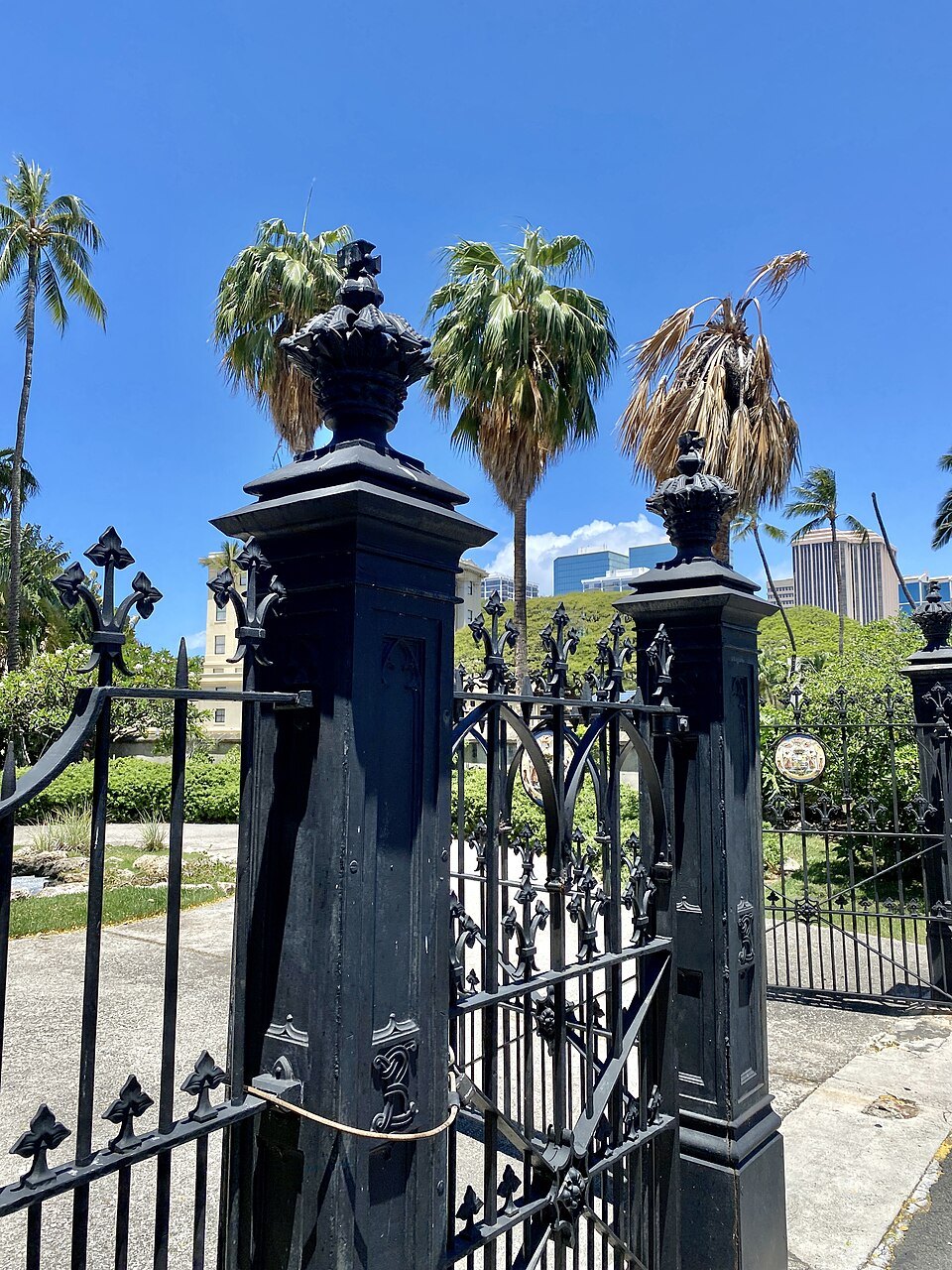
The Hawaiian Mission Houses Historic Site was founded in 1920, a hundred years after the first missionaries landed, and with the church it was made a National Historic Landmark in 1962. The houses show how New Englanders learned to build for the tropics.
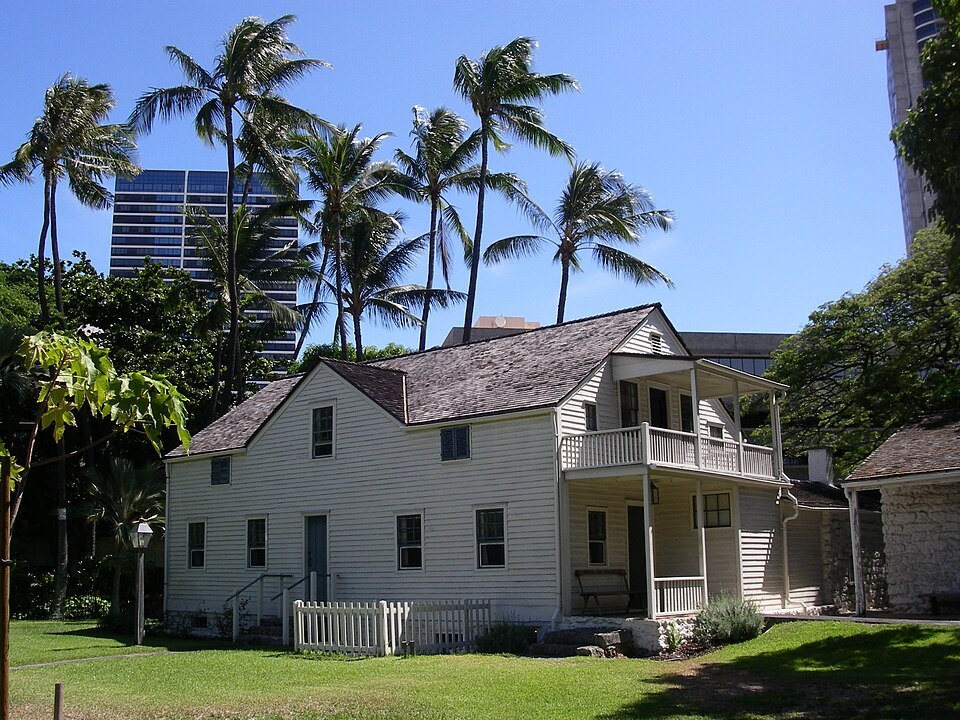
The oldest frame house, Ka Hale Lāʻau, was shipped precut from Boston around Cape Horn and put up in 1821, built for a New England winter with small windows and short eaves. It housed the family of Daniel Chamberlain and often several other missionary families, with a parlor that served as a school. The Chamberlain House, built in 1831 of coral blocks cut from the reef and lumber salvaged from ships, has larger shuttered windows against the sun; it is now the main exhibition hall. The Print House, a coral building added in 1841, shows how missionaries and Hawaiians together produced the first printing in the Hawaiian language.
The archives hold more than 3,000 artifacts and over 12,000 books, manuscripts, letters, diaries and Hawaiian church records from the missionary period of about 1820 to 1863.
What you see
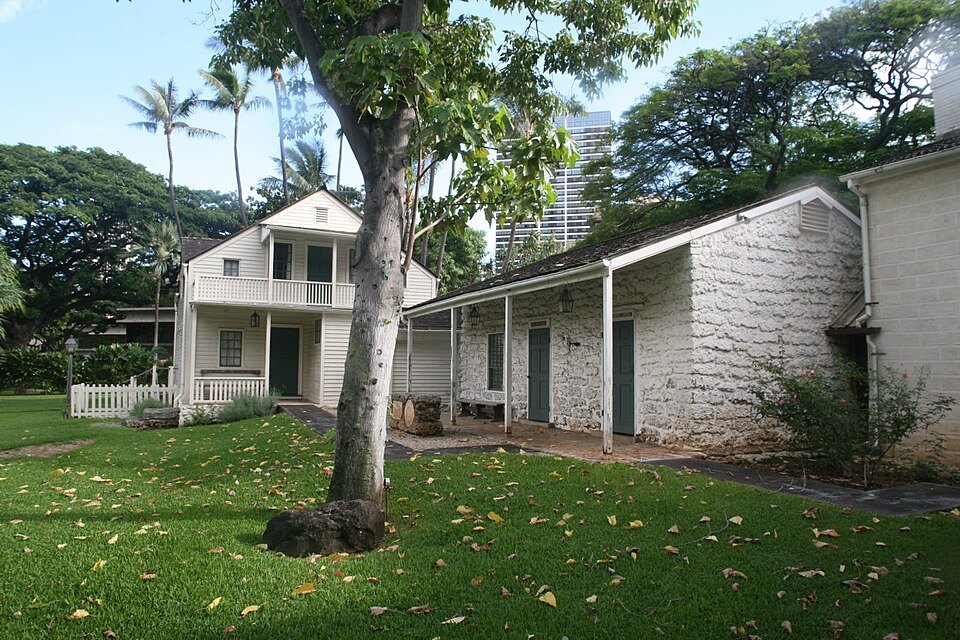
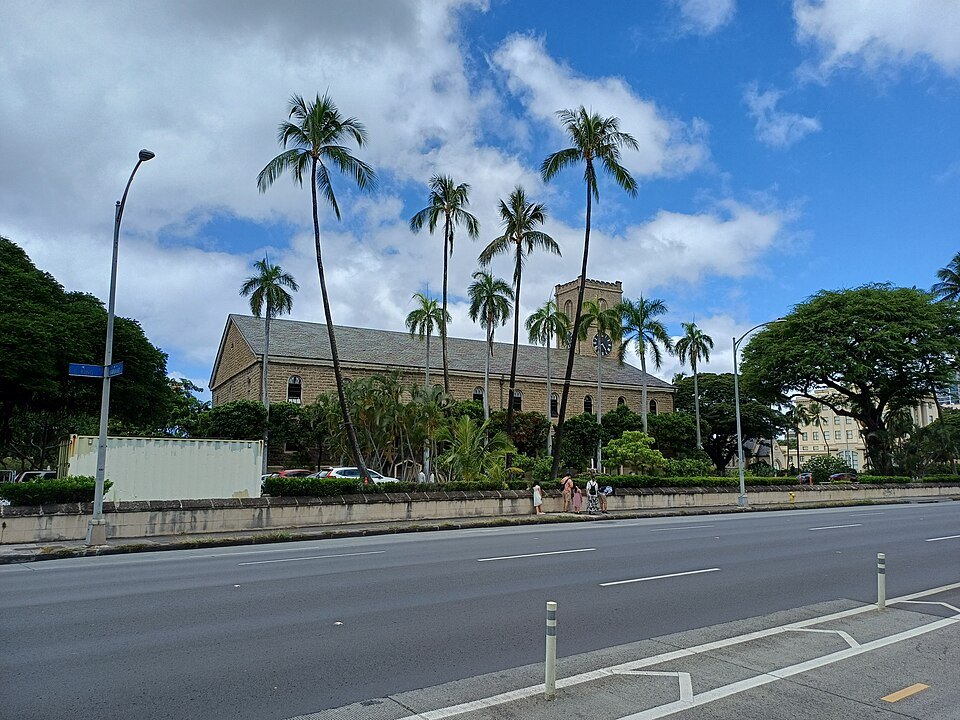
From King Street the church is a long gray block of coral stone under a square clock tower, set back behind lawns and old trees. Inside, the sanctuary is simple and bright, with the gallery portraits above. Beside the church, the Mission Houses stand in a shaded compound: the white wooden frame house, the coral-walled Chamberlain House and the small Print House.
A short walk away at King and Punchbowl streets stands Honolulu Hale, the city hall, finished in 1928 in a Spanish Colonial style with an open courtyard modeled on the Bargello in Florence, and with the Isamu Noguchi sculpture Sky Gate nearby.
How to visit
Kawaiahaʻo is a working church. Visitors are welcome outside services; dress modestly, keep quiet in the sanctuary, and do not photograph worshippers. The Mission Houses are a museum with its own days and tours; check its site before you go, and allow time to read in the exhibition hall. Guided tours of the houses explain the rooms, the medical office of the missionary doctor Gerrit Judd in the frame house, and the outdoor stage built from coral blocks salvaged from the first courthouse in the islands, dating from 1852.
The church is the last stop of the downtown part of the homepage walk, after ʻIolani Palace. Aliʻiōlani Hale and the State Capitol are a few minutes away on foot, and the kingdom page gives the longer history.
Honest notes
The missionaries' story is told here largely through their own houses and records. Their arrival brought literacy in Hawaiian and a written language, and also pressure on Hawaiian religion and custom; in later generations, descendants of missionary families founded many of the businesses that dominated downtown Honolulu. The site's exhibits, and the church, are part of that history rather than a neutral account of it.
Nearby
- NearbyʻIolani PalaceCompleted for King Kalākaua in 1882, the seat of the Hawaiian Kingdom until its overthrow in 1893, the queen's prison in 1895, a government office for most of the twentieth century, and a museum since 1978.Read the page
- NearbyAliʻiōlani Hale and the Kamehameha StatueA government building begun by Kamehameha V in 1872, the home of Hawaiʻi's Supreme Court today, and in front of it the gilded statue of Kamehameha I that arrived in Honolulu in 1883 after the first casting was lost at sea.Read the page
- NearbyThe State Capitol and Washington PlaceA capitol opened in 1969 whose columns are palms and whose chambers are volcanoes, open to the sky; beside it Washington Place, where Queen Liliʻuokalani was arrested in 1895 and lived until her death.Read the page