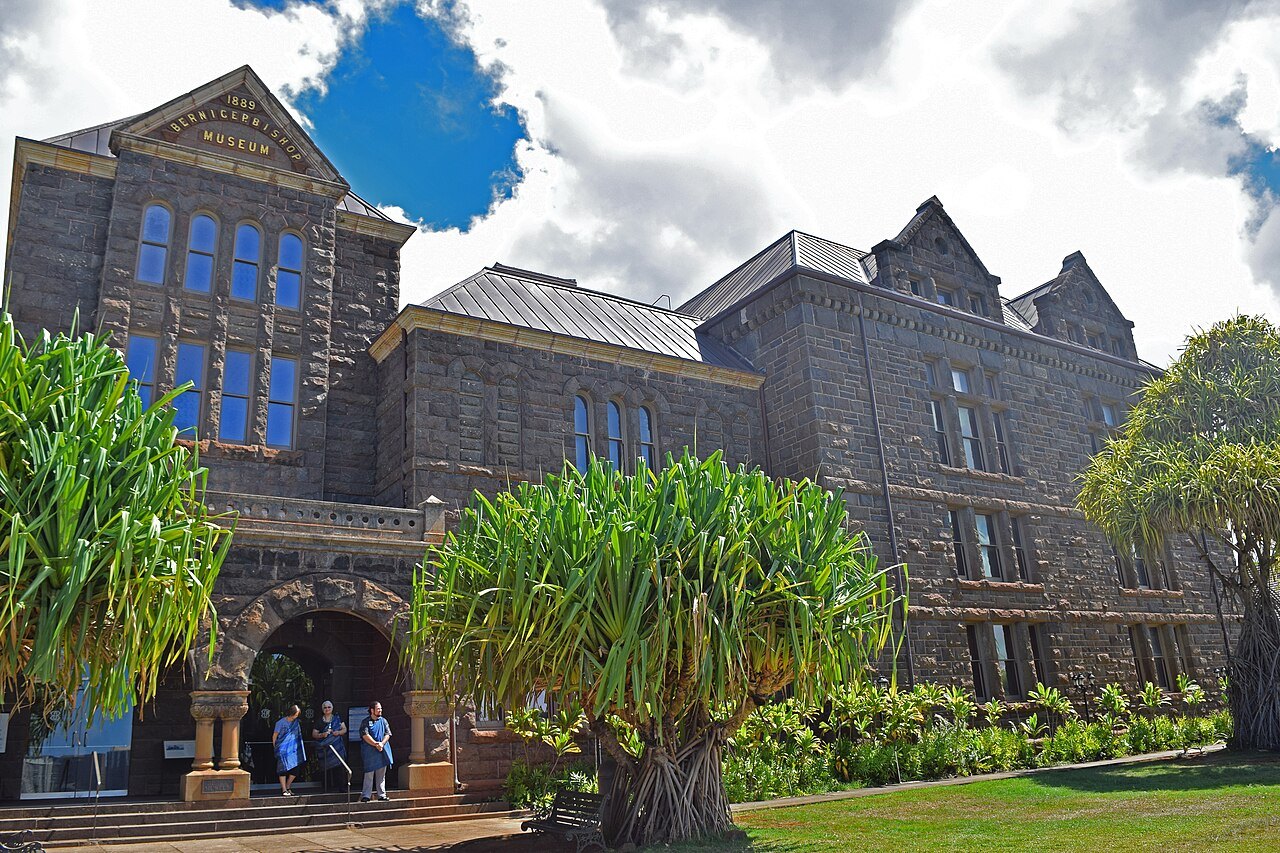
Bishop Museum
- iHawaiian HallA three-story hall of 1898 lined with koa-wood cases, with a whole sperm whale skeleton hanging overhead.
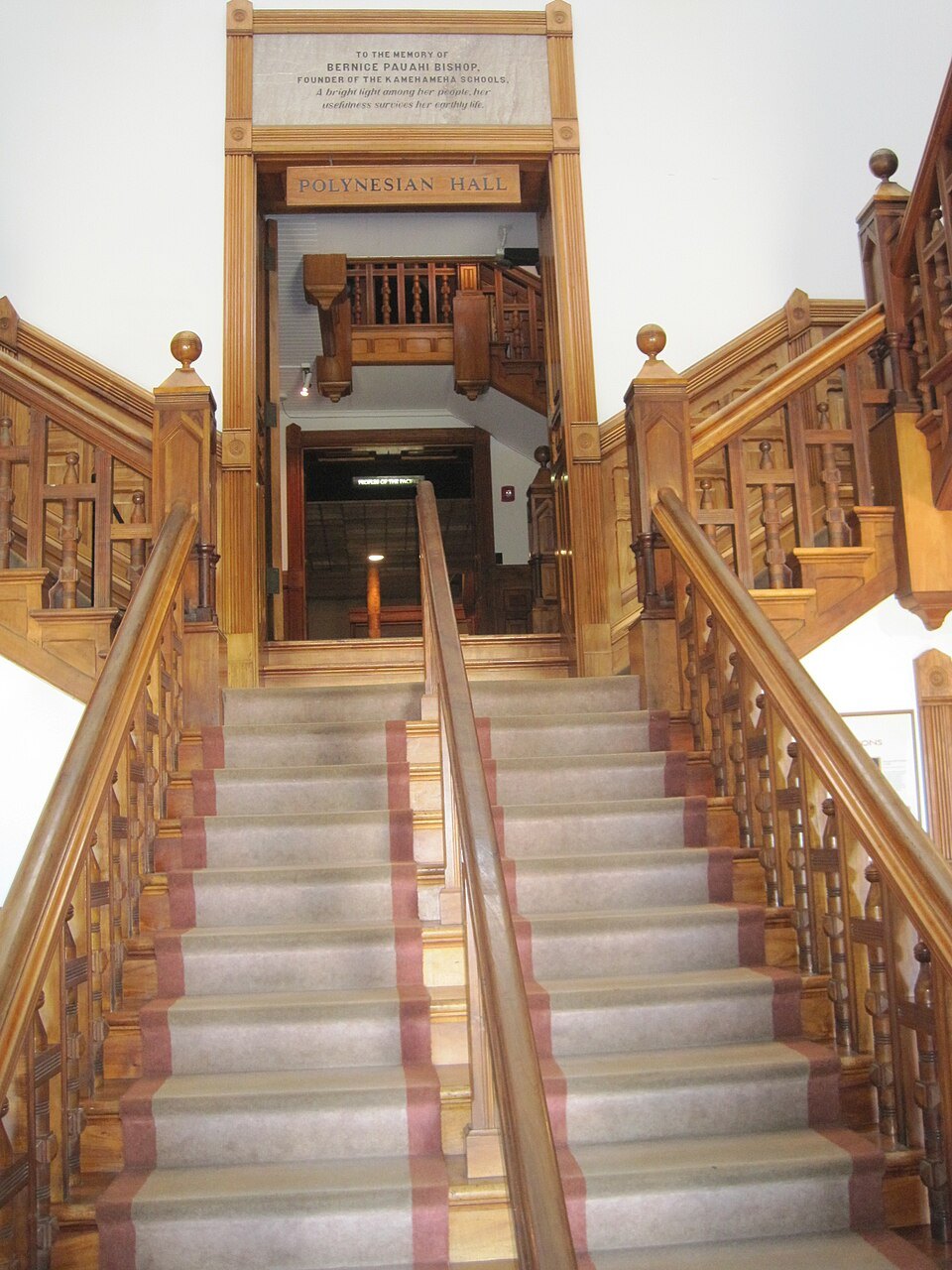
- iiPacific HallThe second of the 1898 stone halls, built as Polynesian Hall, given to the cultures of the wider Pacific.
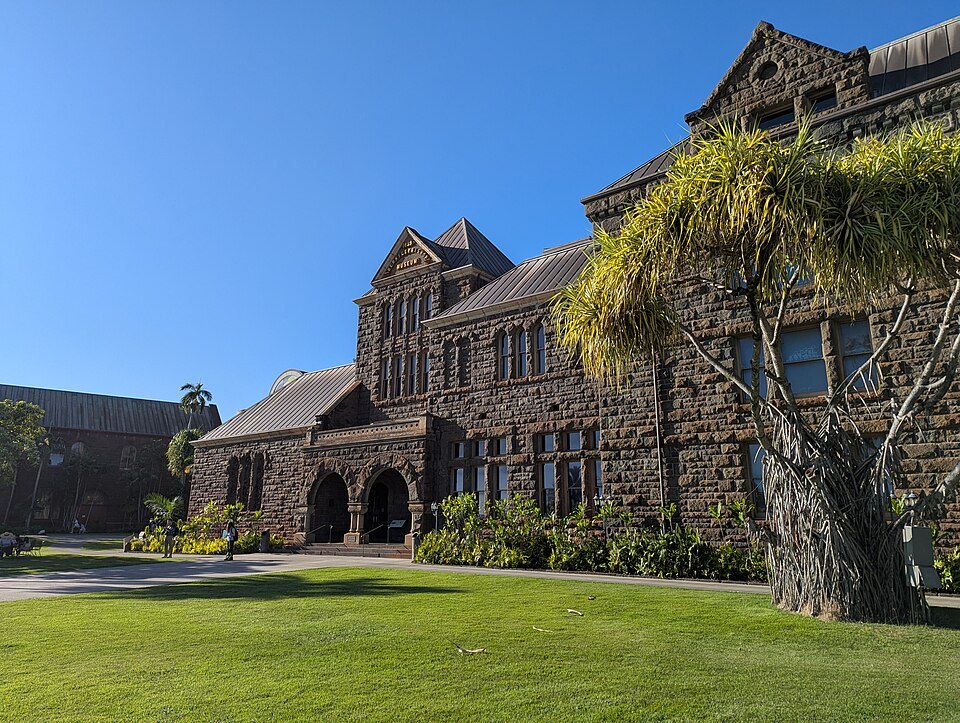
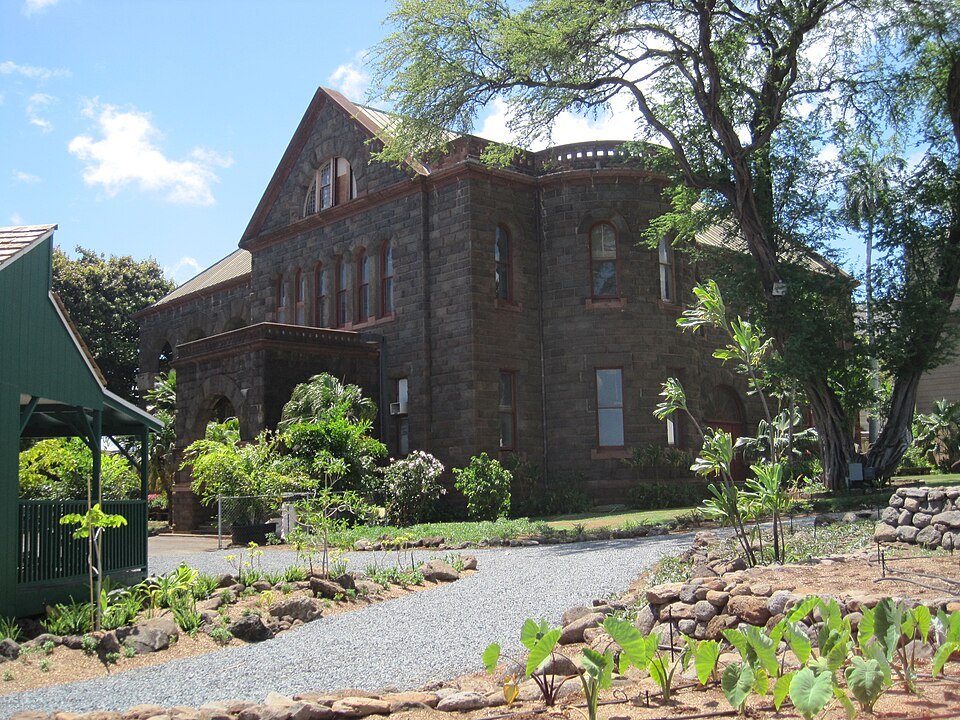
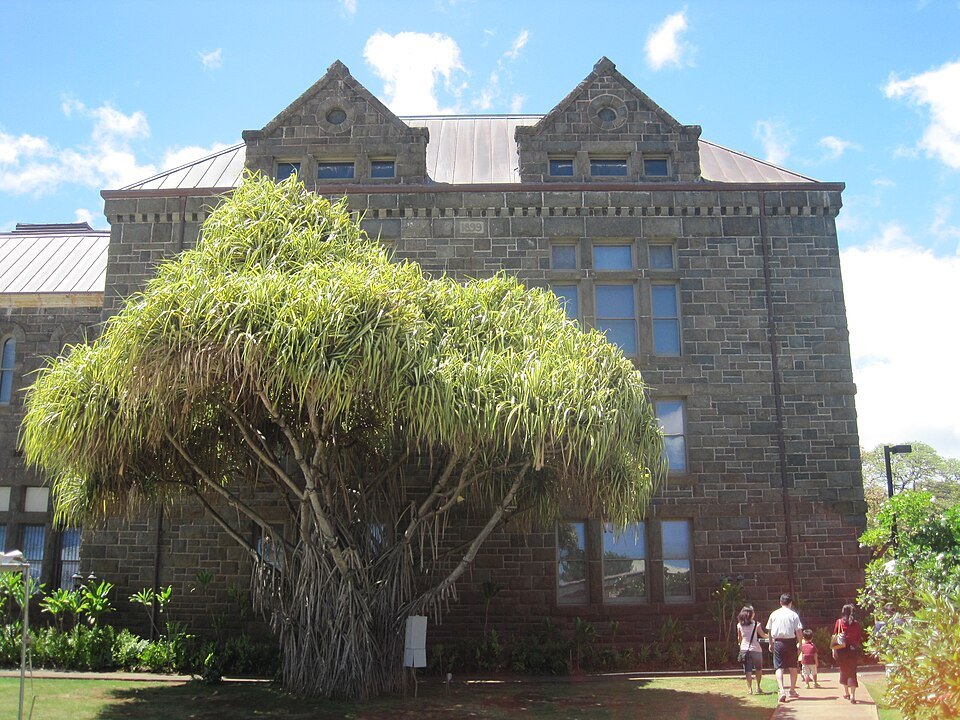
- iiiThe stone buildingsDark volcanic-stone halls in the Richardsonian Romanesque style, called “the noblest buildings of Honolulu” in 1898.
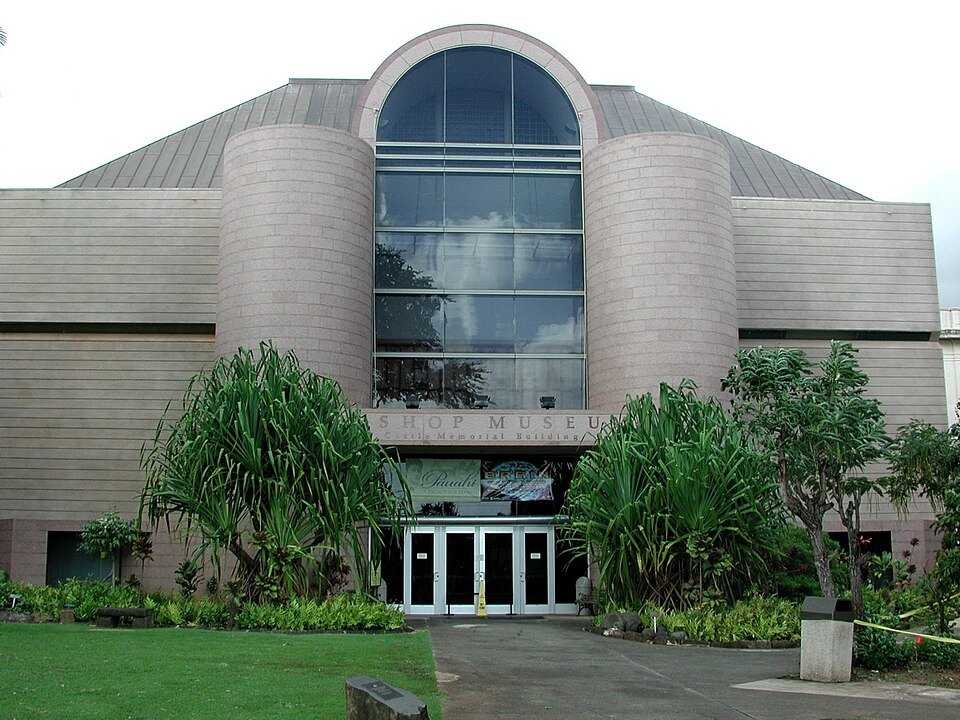
- ivThe Castle Memorial BuildingThe hall for the traveling exhibitions the museum brings from institutions around the world.
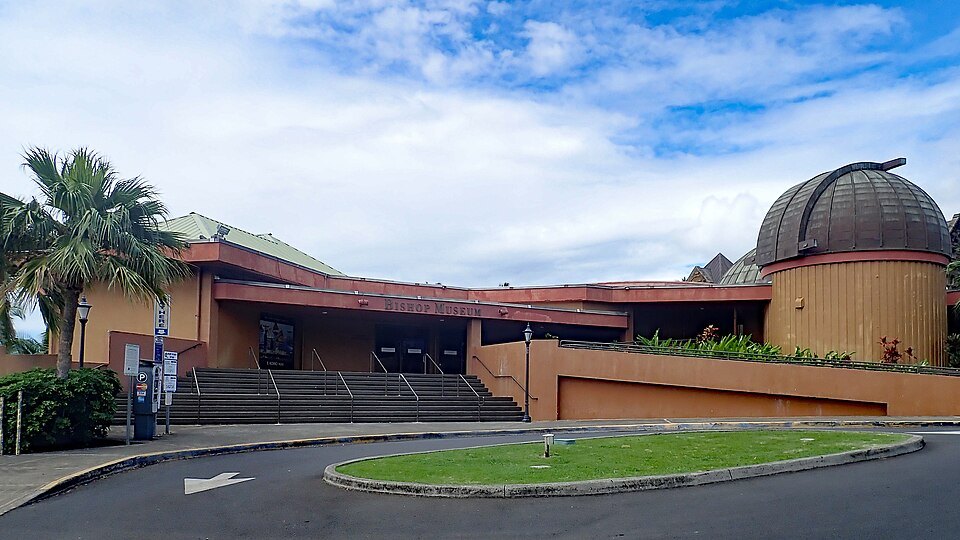
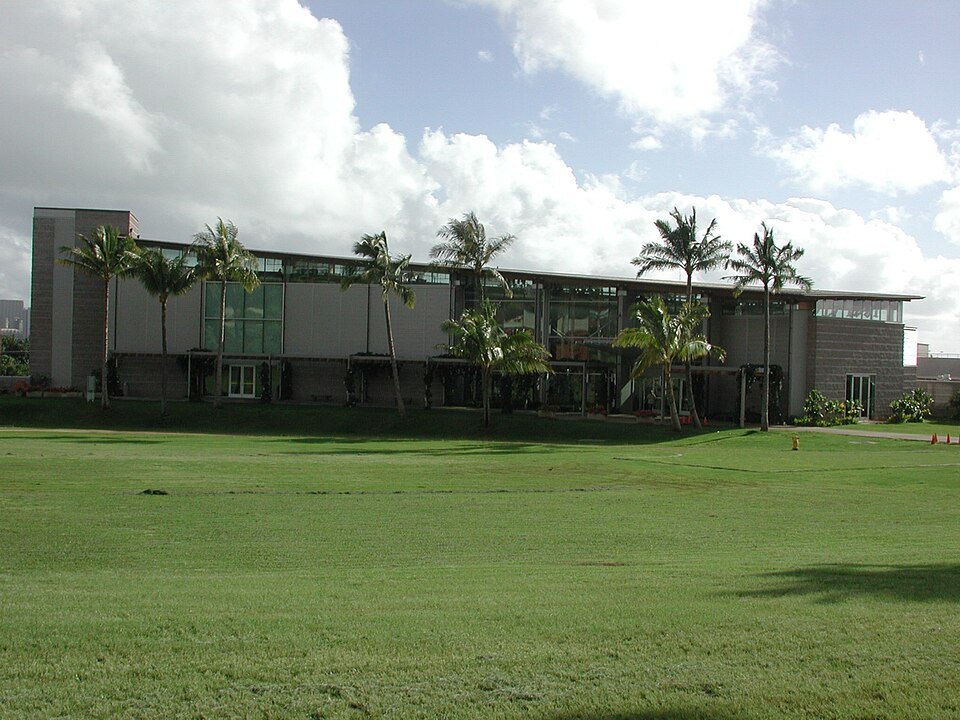
- vThe science center and planetariumHands-on exhibits on volcanoes and the ocean, and a domed planetarium on the lawn.
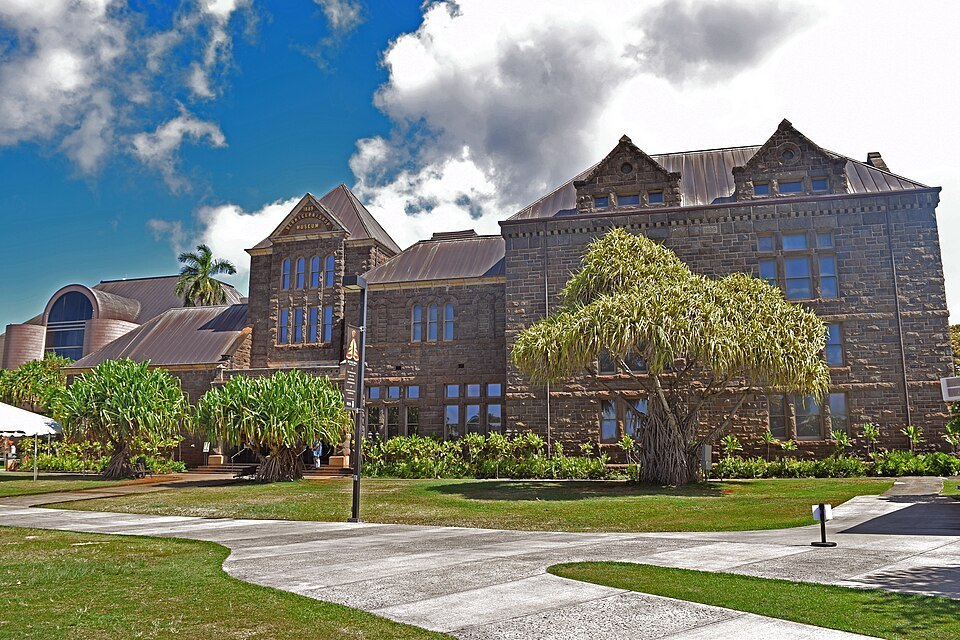
- viThe great lawnThe open grounds between the halls, framed by trees, where the whole campus comes into view.
Reading the place
Why it matters
The Bernice Pauahi Bishop Museum, officially the Hawaiʻi State Museum of Natural and Cultural History, is the largest museum in Hawaiʻi. It holds the world's largest collection of Polynesian cultural artifacts, and its natural history collections run to more than 24 million specimens, including one of the largest collections of insects in the United States. By the late 1980s it had become the largest institution of its kind in Polynesia.
For a visitor it is the best single place in the city to understand what Hawaiʻi was before the harbor and the hotels: how the islands formed, how people first reached them by canoe, how the chiefs and gods and seasons ordered life, and what the kingdom became. A morning here makes the rest of the city, from ʻIolani Palace to the reef at Waikīkī, easier to read.
A museum for a princess
Charles Reed Bishop, a businessman who co-founded the First Hawaiian Bank and the Kamehameha Schools, founded the museum in 1889 in memory of his wife, Princess Bernice Pauahi Bishop, who had died in 1884. She was born into the royal family and was the last legal heir of the Kamehameha dynasty, which ruled the kingdom from 1810 to 1872. Bishop first meant the museum to hold the family heirlooms that had come down to him through his wife's royal line.
In her will, the princess left her lands to found the Kamehameha Schools for Native Hawaiian children, and the museum was built on the schools' original boys' campus in Kalihi. When the schools moved to a new campus in 1940, the museum took over the site, adapted the school's Bishop Hall and replaced most of the other school buildings with its own. Its first curator, William Tufts Brigham, later directed it for twenty years.
The halls
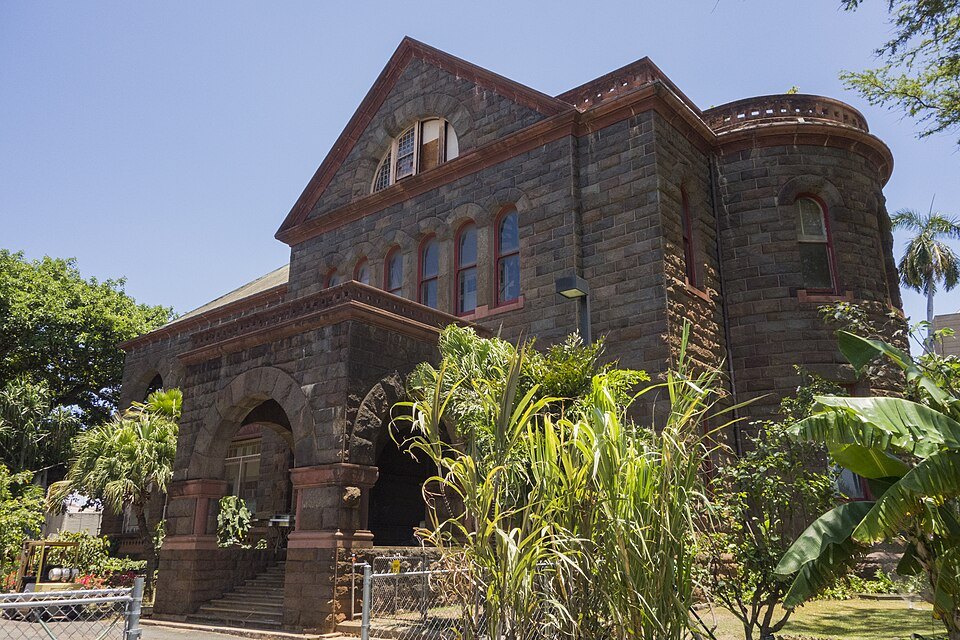
In 1898 Bishop had Hawaiian Hall and Polynesian Hall built in the Richardsonian Romanesque style then fashionable, heavy and dark in volcanic stone; a Honolulu newspaper called them “the noblest buildings of Honolulu.” Both are on the National Register of Historic Places. Seen from the lawn, their rough dark stone, deep-set windows and towers look more like a Victorian college than anything else in the city.
Inside Hawaiian Hall, galleries rise through three stories around an open center, and along the walls stand display cases of koa wood so prized that the wood alone is now said to be worth more than the original buildings. A complete sperm-whale skeleton hangs in the air above the central gallery, with a papier-mâché body alongside it.
Set into the floor of Hawaiian Hall is a stone image of the shark god Kāneikokala, which museum staff have been unable to move through successive renovations. It is treated with respect by the museum and by the Hawaiian community; it is not a photo prop, and visitors should not stand on or touch it.
Other buildings
The Castle Memorial Building, dedicated in 1990, houses the major traveling exhibitions the museum brings from around the world. The Richard T. Mamiya Science Adventure Center, opened in 2005, is a hands-on learning center, mostly for children, with exhibits on marine science, volcanoes and the sciences behind the islands. The domed Jhamandas Watumull Planetarium stands on the lawn.
The museum also runs scientific expeditions and research. In 1924 it sent scientists aboard the four-masted barquentine Kaimiloa on a planned five-year exploration of the Pacific, to collect plants, insects and ethnological material, chart currents and record songs and chants. Its scientists also meant to test the theory, popular then and since disproved, that some Pacific islands were the remains of a sunken continent.
What you see
Arrive on the great lawn and the campus spreads out around you: the dark stone halls with their towers and arched windows, the modern science buildings, and the planetarium dome. Hawaiian Hall is the heart of the museum and the place to begin; Pacific Hall beside it widens the view to the cultures of the rest of the Pacific.
Much of what is displayed in the Hawaiian galleries is sacred: images of gods, feathered cloaks and helmets of the chiefs, objects from burials. The museum shows them with care, and this site does not reproduce them. See them in the halls, read their labels, and follow the museum's rules about photography in each gallery.
How to visit
The museum is in Kalihi, west of downtown, off the usual visitor routes; TheBus lines run there from downtown and Waikīkī (see getting around) (the routes named A, 1, 2, 7 and 10 when this was written). It keeps its own days and hours and charges visitors for admission; check its site before you go, and look at what traveling exhibition is on.
Give it a long visit. Hawaiian Hall alone rewards a slow walk through all three floors, and families will want time in the science center. Pair it with a visit to the palace on another day, and read the kingdom page for the history the halls illustrate.
Honest notes
Some objects in the museum's collections have disputed histories. A wooden image of the war god Kū, bought at a Paris auction in 2017 and given to the museum in 2018, was catalogued as dating from about 1780 to 1820, but specialists in Pacific art have questioned its age, and the question is not settled. A museum of a colonized people's heritage carries debates like this, about origin and about who should hold such things, and the museum's exhibitions have not avoided them.
Nearby
- NearbyChinatownOne of the oldest Chinatowns in the United States, burned in 1886 and again in January 1900, and rebuilt in the low masonry blocks that line Hotel, King and Maunakea streets today.Read the page
- NearbyFoster Botanical GardenThirteen and a half acres of giant trees and orchids at the edge of Chinatown, begun by a German doctor in 1853 and left to the city by Mary Foster, with a sacred fig grown from the Bodhi tree.Read the page
- NearbyPunchbowl: The National Memorial Cemetery of the PacificA national cemetery laid out in 1949 inside the crater the Hawaiians called Pūowaina, where some 53,000 veterans and their families lie, and where a memorial of 1964 records the names of 28,788 Americans missing in the Pacific wars.Read the page