Home · Sights · The State Capitol and Washington Place
The State Capitol and Washington Place
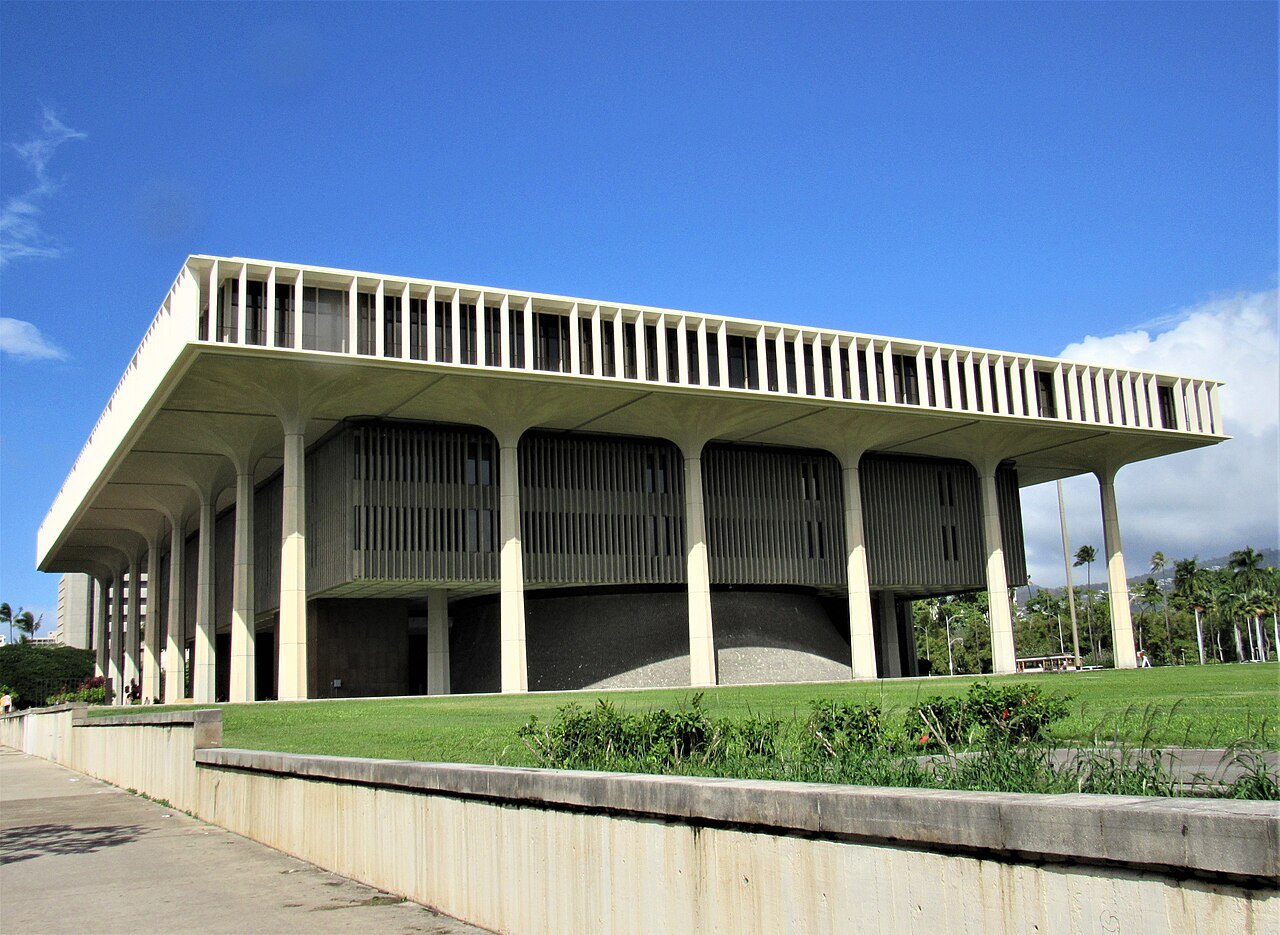
- iThe open atriumThe center of the building, left open to the sky where other capitols put a dome.
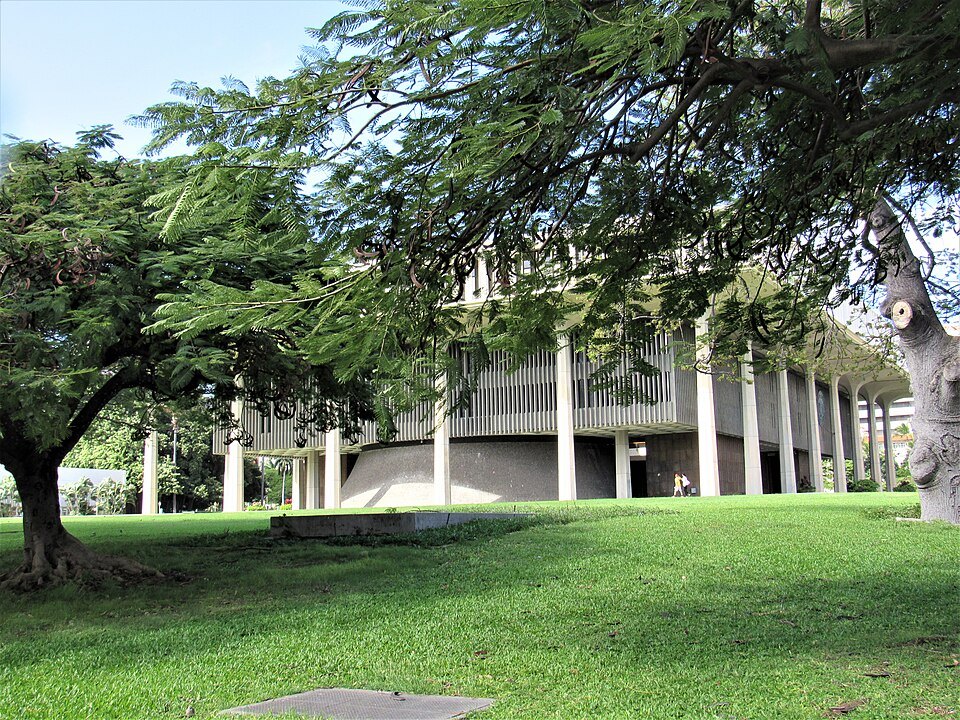
- iiThe palm columnsTall columns shaped like royal palms, set in rows of eight for the eight main islands.
- iiiThe volcano chambersThe two legislative chambers, built as cones to stand for the volcanoes that made the islands.
- ivQueen Liliʻuokalani's statueThe last monarch in bronze on the mall between the Capitol and ʻIolani Palace, dedicated in 1982.
- vFather DamienMarisol Escobar's bronze of the priest of Molokaʻi at the entrance, taken from a late photograph.
- viWashington PlaceA white Greek Revival house of the 1840s with two-tiered verandas, the queen's home until 1917.
Reading the place
Why it matters
Behind ʻIolani Palace stands the building that replaced it. For most of the twentieth century the palace served as the capitol of the territory and then of the state; in 1969 the government moved into this new Hawaiʻi State Capitol, and the palace could be restored. The two, a royal palace and a modernist statehouse, face each other across a lawn, and together they tell the whole arc from kingdom to state.
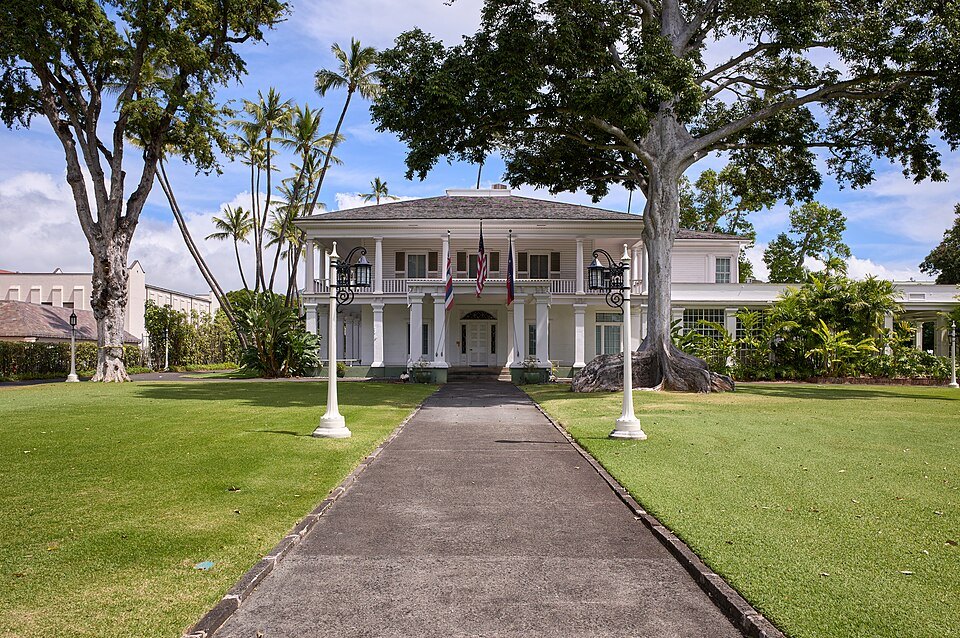
A few steps away is Washington Place, the house where Queen Liliʻuokalani lived as a princess and as queen, where she was arrested after the overthrow, and where she died in 1917. For most of the century after that it was the governor's residence.
A capitol made of the islands
The Capitol opened on 15 March 1969, commissioned and dedicated by John A. Burns, the second governor of the state. It was designed by the Honolulu firm Belt, Lemon and Lo with John Carl Warnecke and Associates, in a local adaptation of modernism that is sometimes called Hawaiian international architecture. Instead of copying the dome of the United States Capitol, as most statehouses do, every part of it stands for something in nature.
A reflecting pool around the building stands for the Pacific Ocean. The two legislative chambers are cone-shaped, like the volcanoes that formed the islands. The columns on the outside are shaped like royal palms and stand in rows of eight, for the eight main islands, and sets of eight repeat through the building; sets of four stand for the four counties. The center of the building, where a rotunda would be, is left open to the sky, so sun, wind and rain come in; it is sometimes said that the sky is Hawaiʻi's capitol dome, and when it rains a rainbow can appear inside.
From the atrium you can see through glass walls into both chambers and their chandeliers by the German-American artist Otto Piene: a sun of gold-plated globes in the House, and a moon made of 620 chambered nautilus shells in the Senate.
The monuments on the grounds
On the mall between the Capitol and the palace stands the bronze statue of Queen Liliʻuokalani, dedicated on 10 April 1982; it faces the palace she was deposed from. At the entrance on the other side stands Father Damien, the Belgian priest who died in 1889 after sixteen years caring for patients with leprosy on Molokaʻi, and who was made a saint in 2009. The New York sculptor Marisol Escobar worked from a photograph taken near the end of his life, which is why he wears glasses and looks nothing like a heroic statue; a second cast stands in the United States Capitol beside Kamehameha.
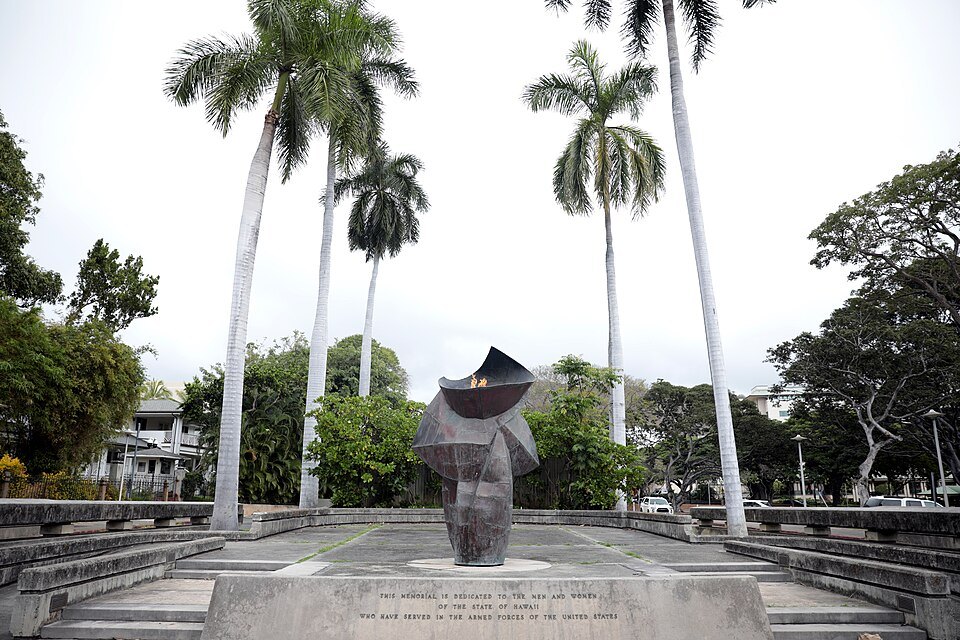
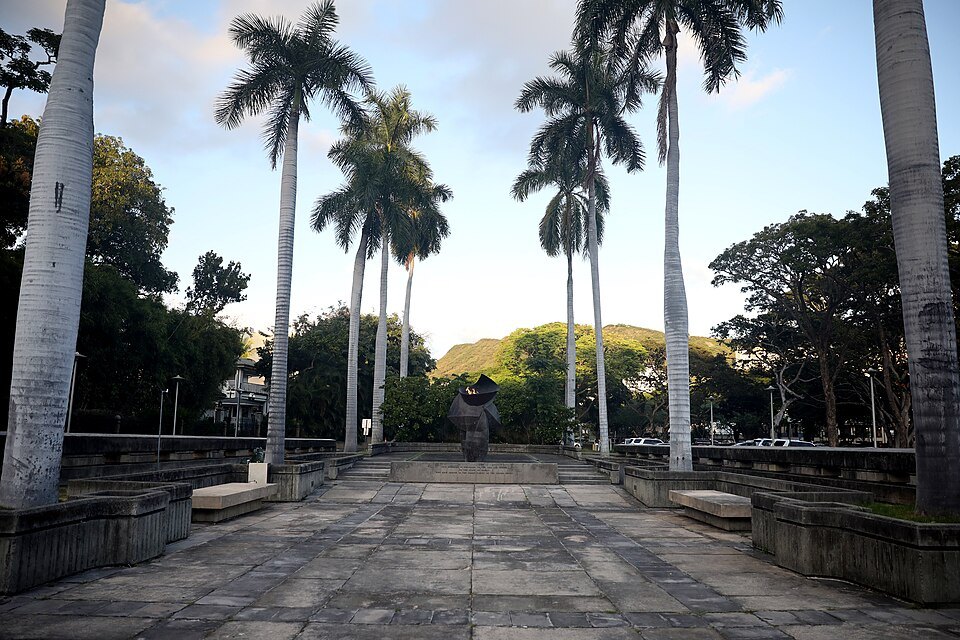
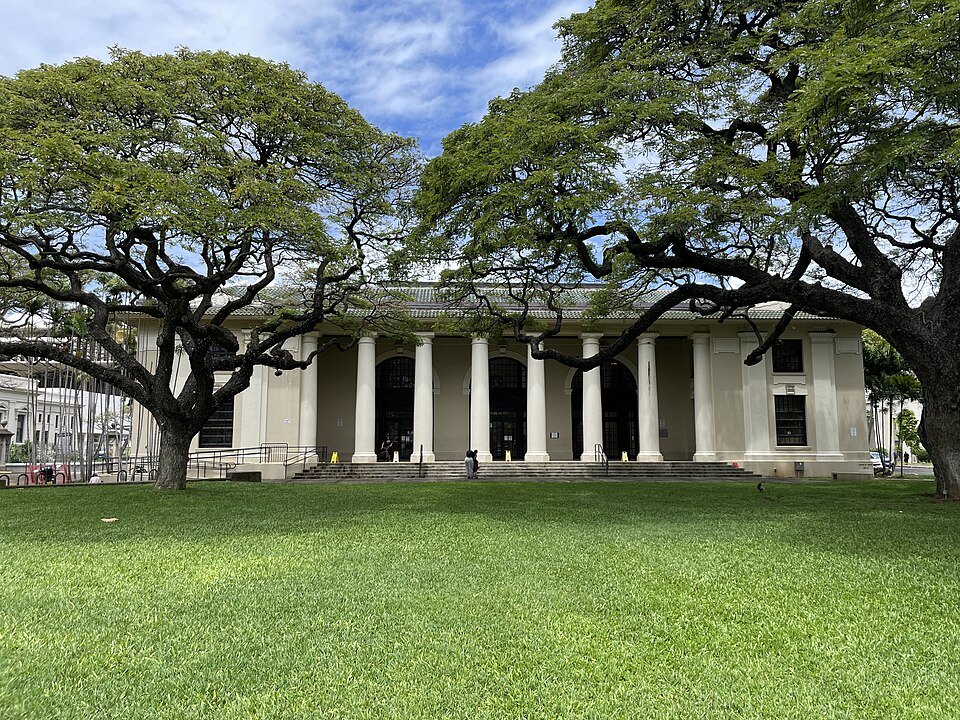
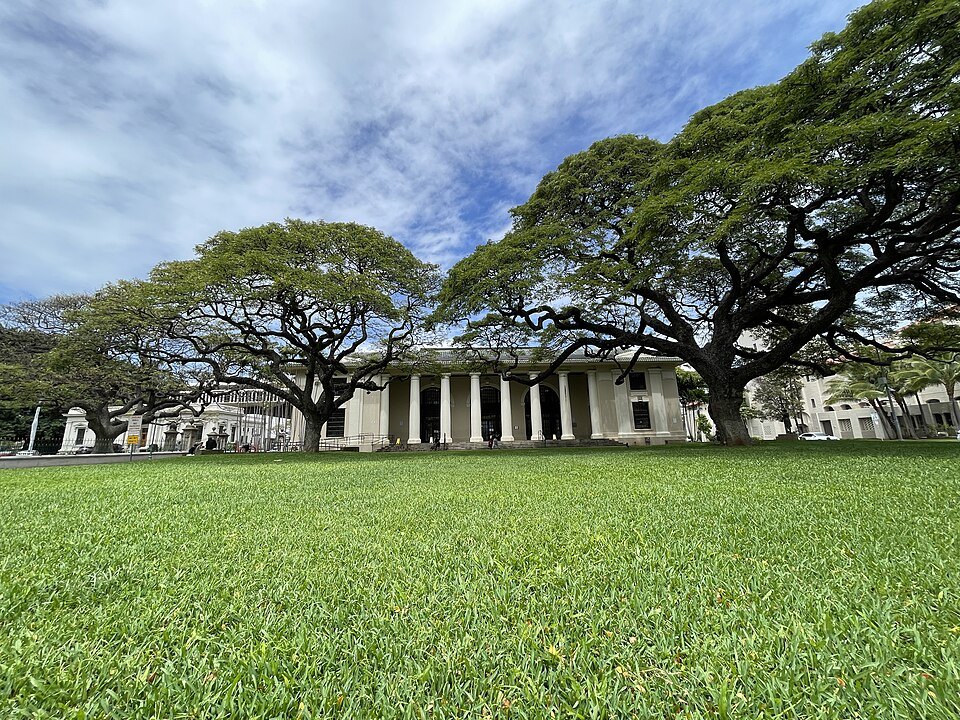
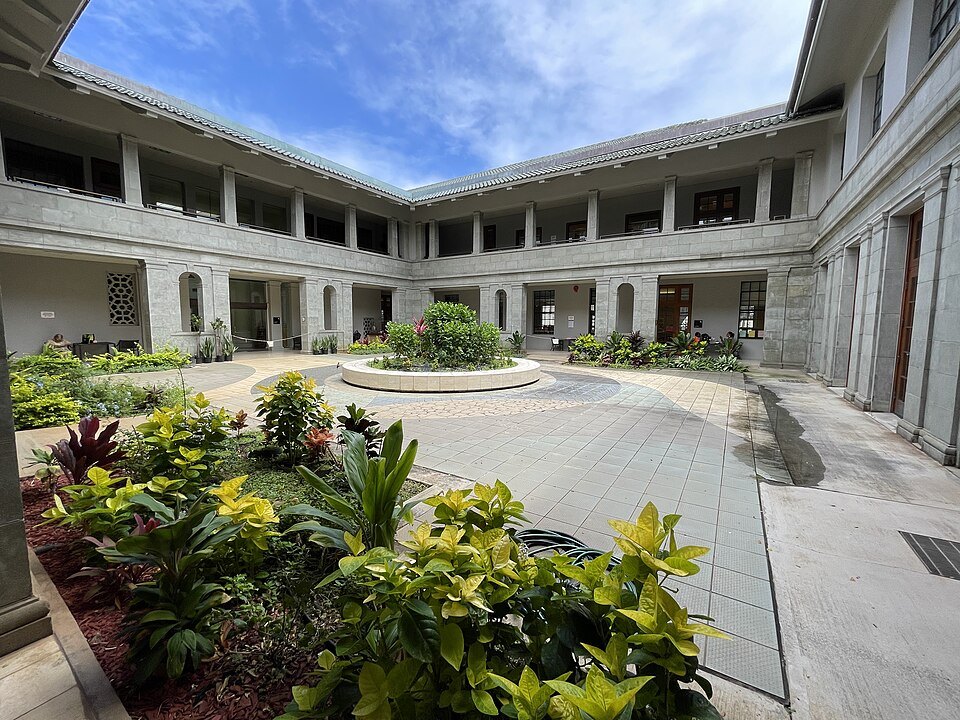
On Beretania Street, the Eternal Flame honors the people of Hawaiʻi who served in the armed forces. Next to the Capitol stands the Hawaiʻi State Library, a building funded by Andrew Carnegie and finished in 1913, which the architect C. W. Dickey later enlarged around an open-air courtyard. Two bronzes by Barbara Hepworth stand on its front lawn, and its children's room is painted with murals of Hawaiian legends by Juliette May Fraser.
Washington Place
Washington Place was built in the 1840s for John Dominis, an American sea captain who sailed for China in 1846 to buy furniture for it and was never heard from again. His widow, Mary, kept the house and rented rooms; their son, John Owen Dominis, married the future Queen Liliʻuokalani in 1862, and it became her private home. The house is Greek Revival, with coral-stone lower walls and columns, a wooden upper floor, two-tiered verandas on every side and a hipped roof.
After the overthrow of 1893, the deposed queen was arrested at Washington Place in 1895 by forces of the Republic of Hawaiʻi, tried by a military tribunal, and imprisoned at the palace; after her release she was confined here for several months. William Little Lee, the lawyer who drafted the Great Māhele, the division of land that brought private ownership to the islands, had lived here in the 1850s.
She lived in the house for the rest of her life and died in its downstairs bedroom on 11 November 1917; in her memoir, Hawaiʻi's Story by Hawaiʻi's Queen, she called it “a palatial dwelling.” Earlier that year she had raised the American flag over the house in honor of five Hawaiian sailors lost when a German submarine sank the SS Aztec, an act many read as a sign of her support for the United States. In 1921 the territory bought it as the governor's official residence, which it remained until 2002. A new residence stands behind it, and the historic house is a museum.
How to visit
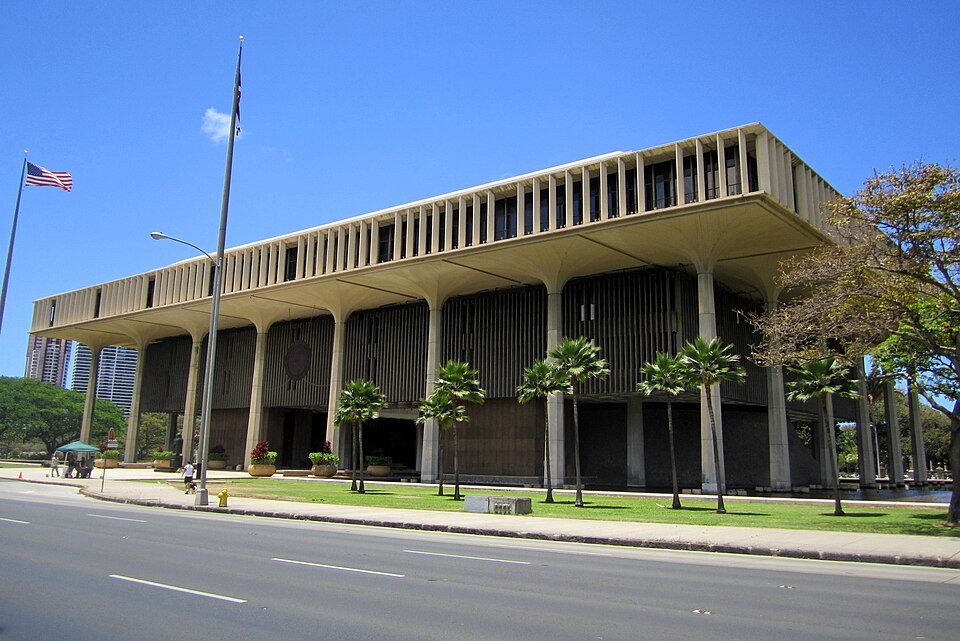
The Capitol's atrium and grounds can be walked through, and the building is at its most striking from the mall on the palace side, looking up at the columns. The reflecting pool has had an algae problem since 1969 and has been drained and fenced during repair work in recent years, so do not count on seeing it filled. Washington Place is a museum house whose visits are arranged ahead; check its own page for whether and how you can go in.
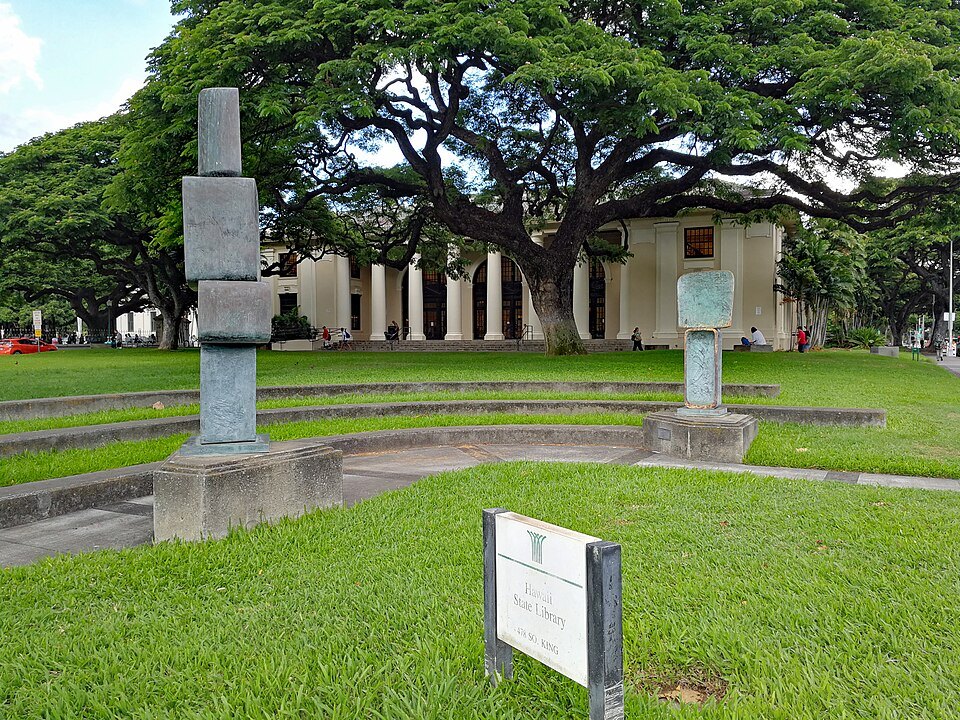
The second floor of the nearby No. 1 Capitol District Building holds Capitol Modern, the Hawaiʻi State Art Museum, which shows works from the state's own collection of public art. Pair the whole district with Aliʻiōlani Hale and Kawaiahaʻo Church; the kingdom page sets out the history in order.
Nearby
- NearbyʻIolani PalaceCompleted for King Kalākaua in 1882, the seat of the Hawaiian Kingdom until its overthrow in 1893, the queen's prison in 1895, a government office for most of the twentieth century, and a museum since 1978.Read the page
- NearbyAliʻiōlani Hale and the Kamehameha StatueA government building begun by Kamehameha V in 1872, the home of Hawaiʻi's Supreme Court today, and in front of it the gilded statue of Kamehameha I that arrived in Honolulu in 1883 after the first casting was lost at sea.Read the page
- NearbyKawaiahaʻo Church and the Mission HousesThe church the Hawaiian kings took their oaths in, built between 1836 and 1842 of some 14,000 blocks of coral that divers cut from the reef, and beside it the houses of the missionaries who arrived in 1820.Read the page